May 22-23: Kruger Highlights!

NOTE, I am going to try something different with the videos today, in part because they are long ones (you will see why). I understand that downloading them on your device is taking a long time, at least for some of you, and this is probably due to my website host, Hostinger. SO, based on Nathan’s suggestion, I am going to try providing you a Youtube link to each video instead of embedding them in this blog. That means you will leave the blog and go to Youtube to see the video, but then you will have to return to the blog to continue – it won’t happen automatically. Try not to get distracted on Youtube as there will be many other videos on the channel and you could easily lose the continuity of the blog post. Let me know how this works.

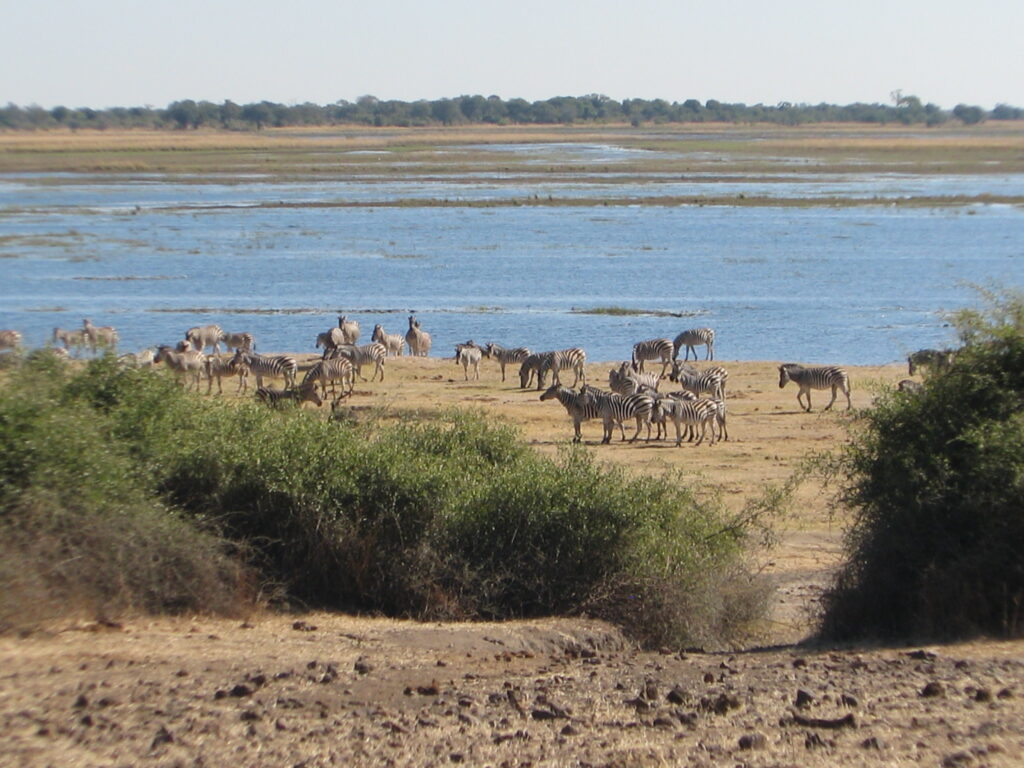
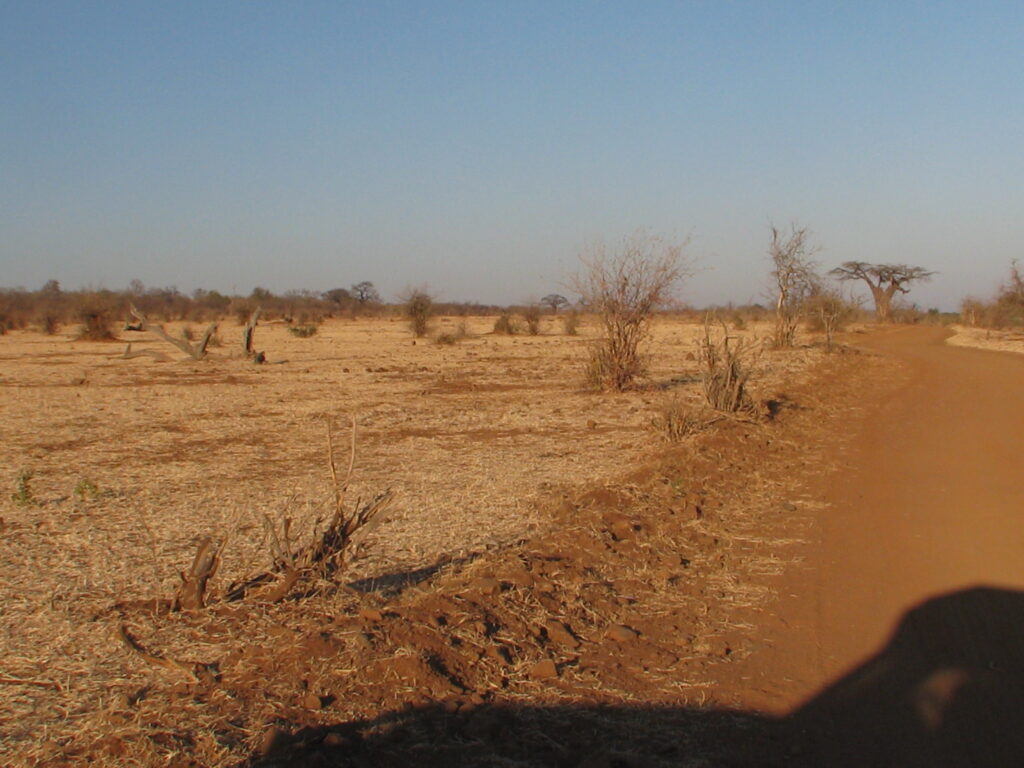
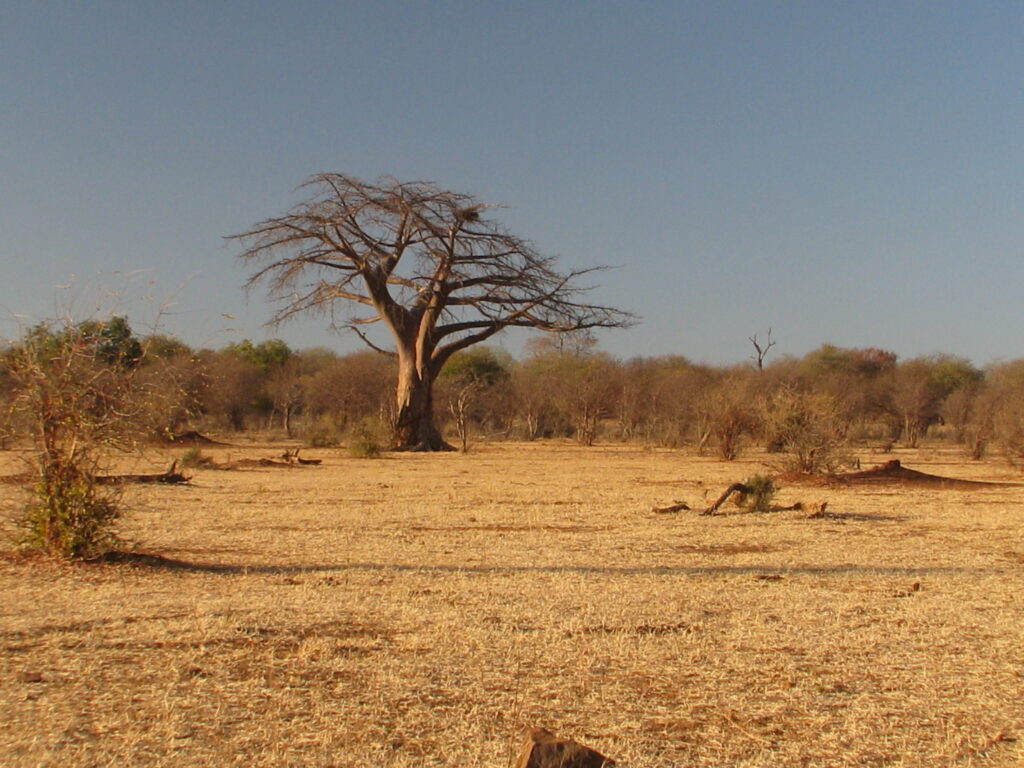
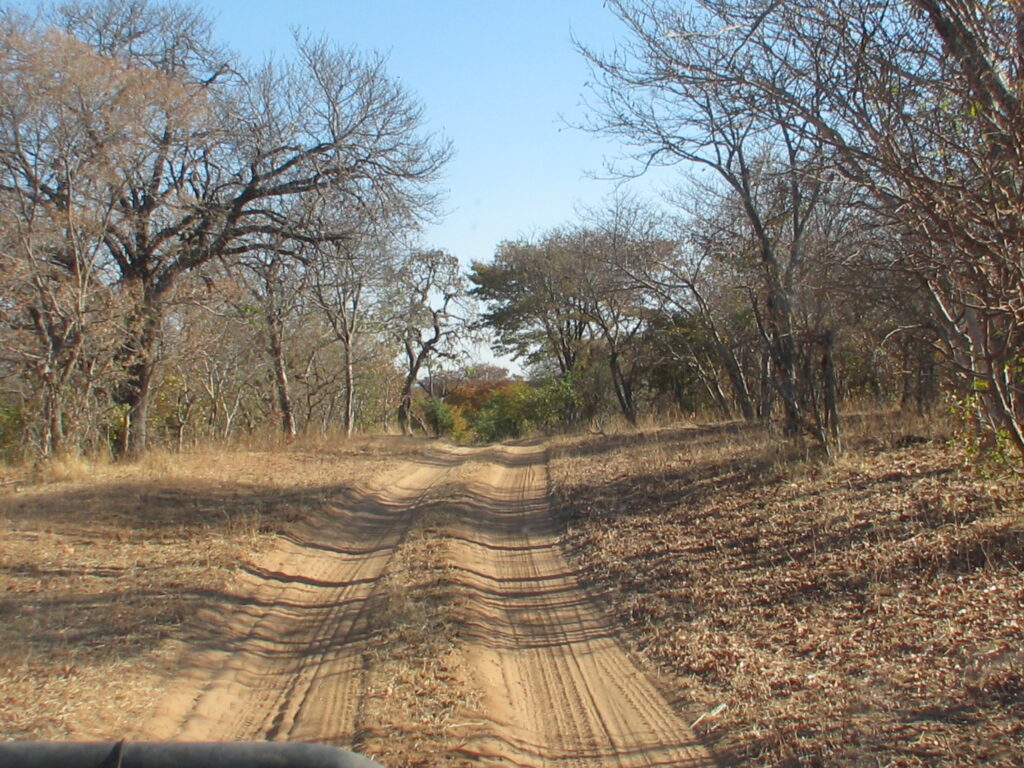
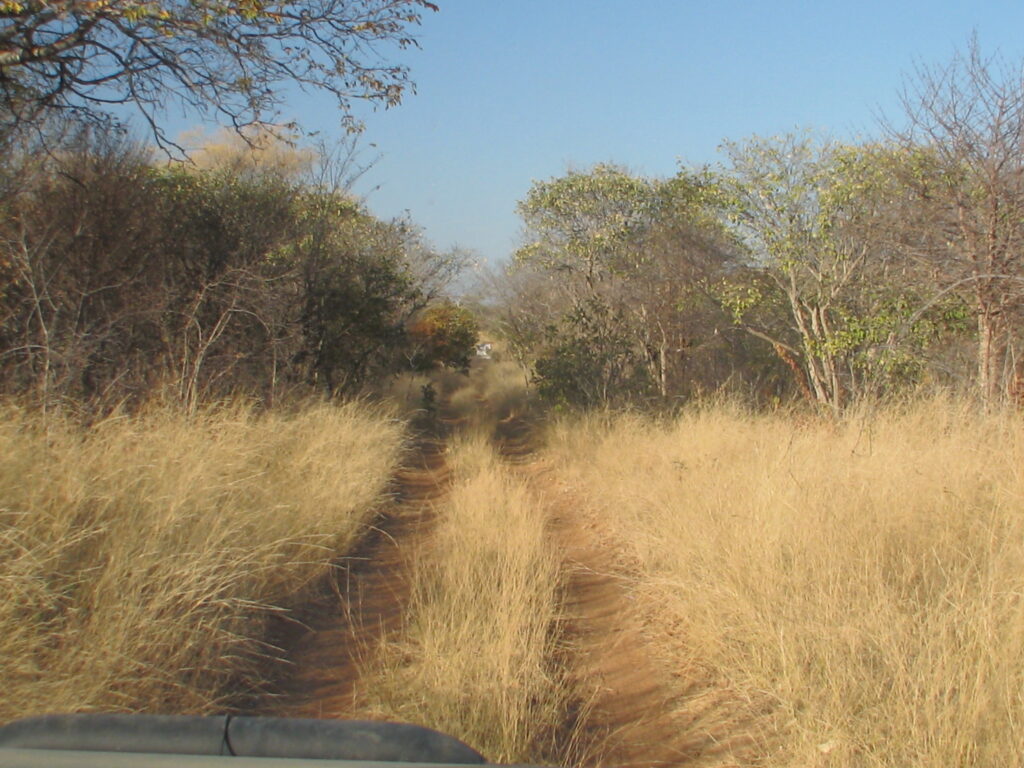
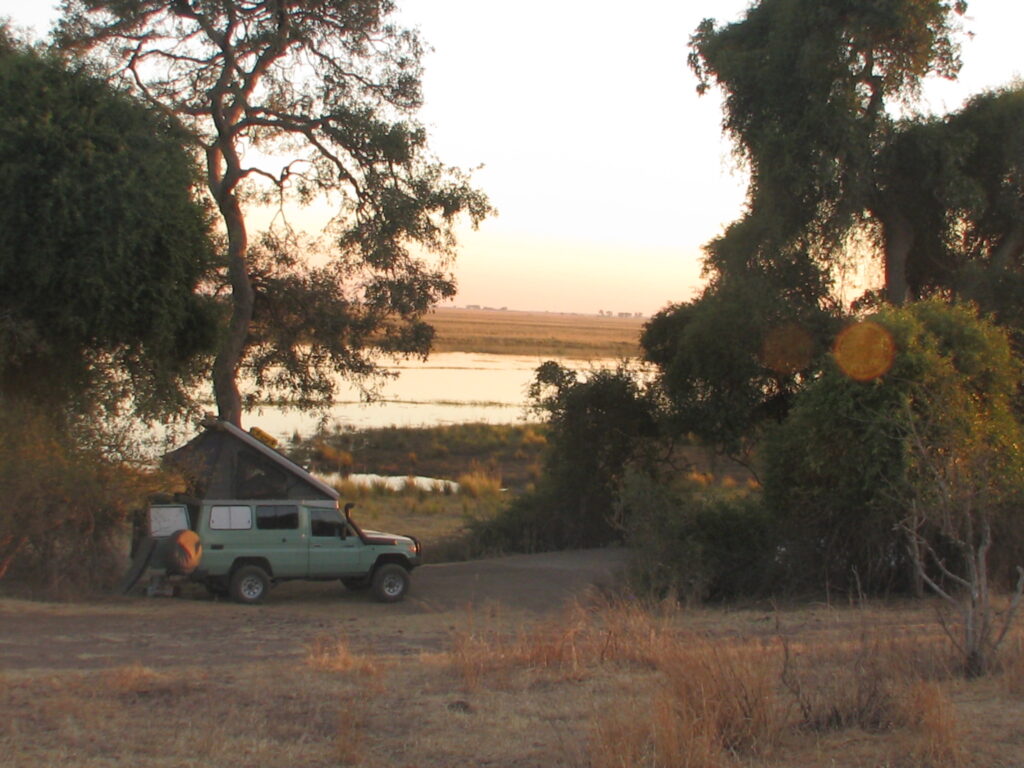
First, before getting to the exciting highlights section, let me describe my journey north from my last campsite at Setara to my new campsite at Letaba (which I won’t say anything about because it was just another Kruger campground, small city just like Satara). As I mentioned last time, as I moved north through Kruger the environment changes a bit and the landscape becomes increasingly dominated by mopane woolands, which is dominated by the mopane tree that I discussed last time. Here are a few shots of the mopane woodland, noting that in most places the mopane trees are sort of stunted in growth so they appear more scrub-like than full trees, but in some places they take on greater stature, and they will get larger as I continue north:

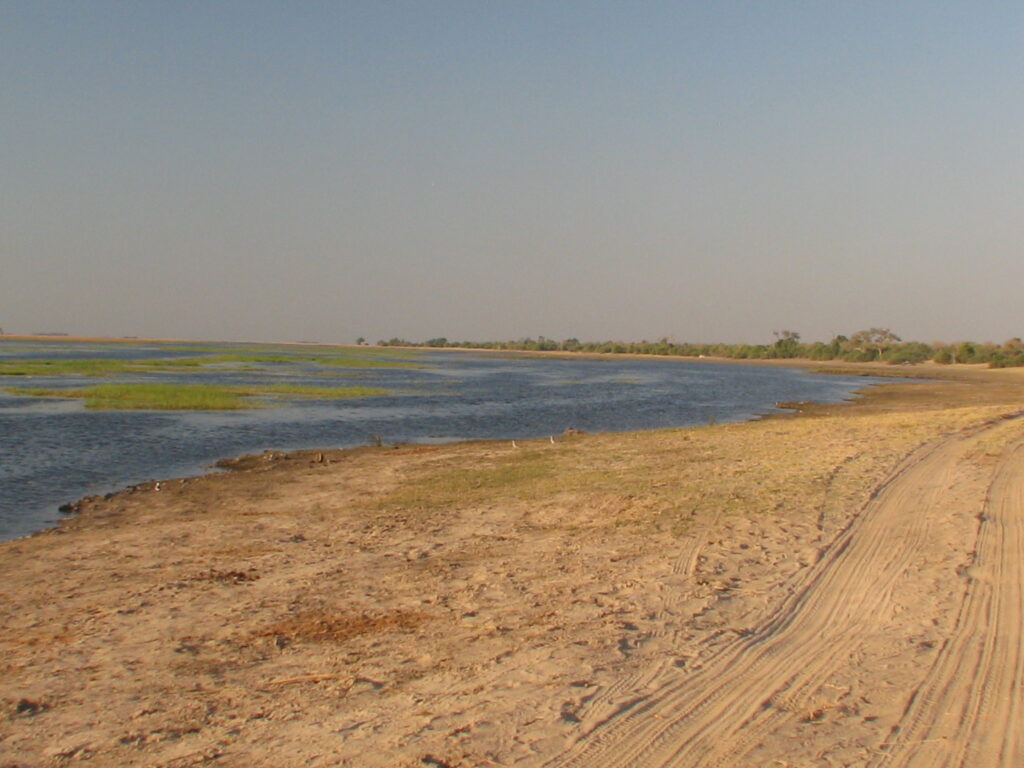
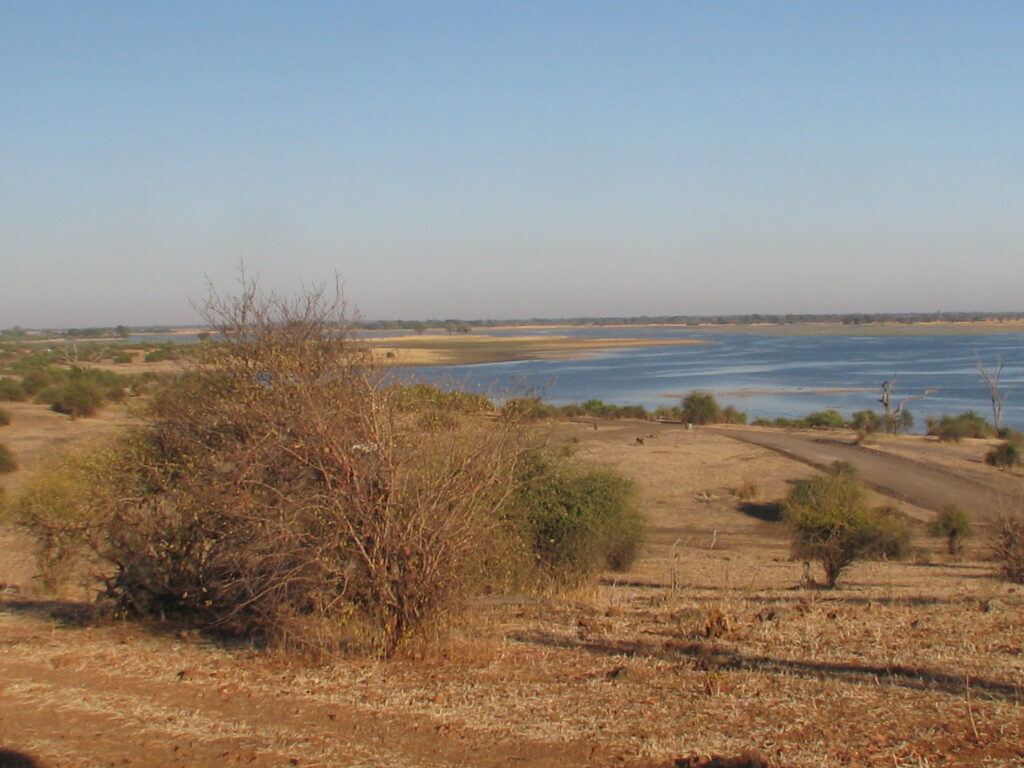
Not too exciting I know, but hey, that’s mopane woodland – at least the stunted version. I also encountered a couple of large river valleys with flowing water – they must be something to see during the rainy season when they are at flood stage:

Olifant River
Letaba River

There are also quite a few of these rocky hills (or “koppies” as they are called) that stick up out of the plains in isolation that provide some really nice relief to the landscape – and they look like they should have all kinds of cool animals on them:

OK, now I want to share a few Kruger highlight experiences. There’s lots more to share in terms of animals sites and sounds, but they will have to wait.

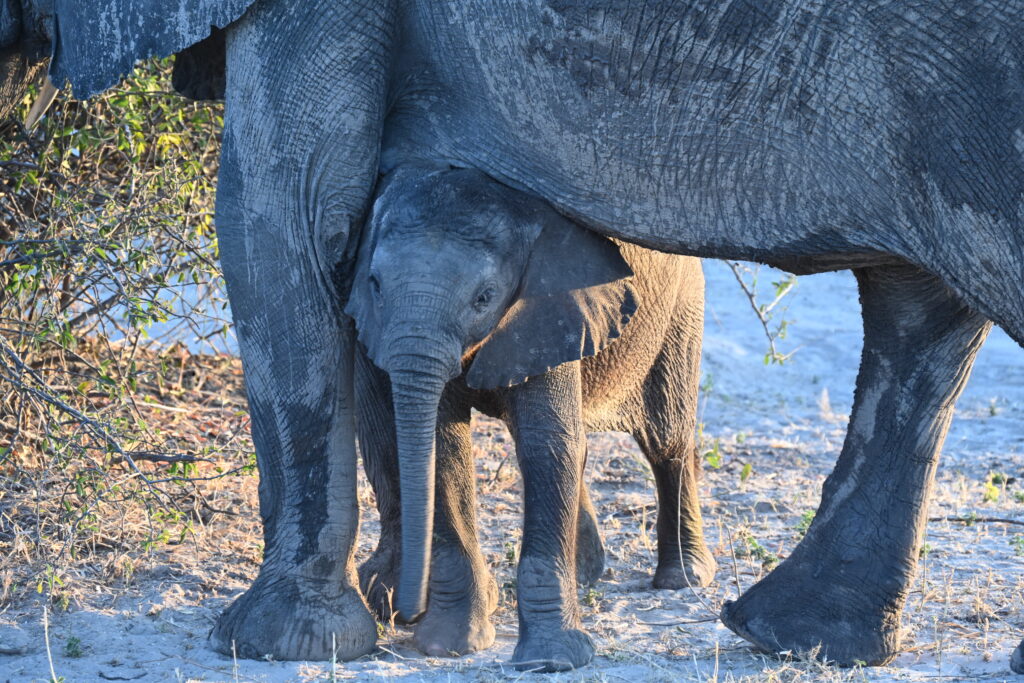
#1. African savannah (a.k.a. “bush”) elephant. My first highlight is none other than the magnificant African elephant. But before getting to the video, let’s talk a little about why elephants are so important and why they are probably my favorite animal here to observe in the wild. The African savannah elephants is what we call a “keystone” species; that is, a species that has a greatly disproportionate influence on the ecosystem given its abundance or biomass. In this case, although elephants are big, well actually they are huge, they don’t amount to that much biomass relative to many other organisms that make up for their diminutive size by their shear numbers. However, elephants have a massive impact on the ecosytem in terms of structure and function, and through their activities they affect the habitat of numerous other organisms. Indeed, many organisms practically owe their existence to elephants.

Let me give just a couple examples to illustrate what I am talking about (but there are many more examples that we could draw from).

Example 1. Elephants physically alter the environment in many ways. For example, elephants dig holes in the ground with their feet – sometimes aided by their tusks. They do this for a variety of reasons, one of which is to get at minerals to include in their diet. By creating these holes, water will collect in them and the elephants will return to drink and take mud baths – which they do to protect their skin from the sun. Their repeated visits will gradually enlarge the holes and they can become seasonal or even permenant water holes, which then provide water and habitat for a whole host of other organisms. In some parts of Africa, the actions of elephants to create water holes is the only means of creating this critical habitat. In these areas, without elephants, in the long run, many water hole/wetland dependent organisms would disappear. Here is a series of photos I took today to show the idea of the progression in the development of a water hole by elephants:

Example #2. Elephants eat a lot! By a lot, I mean that an average adult can eat 300-400 pounds of plant material every day. That’s a lot of organic matter going in, but what comes out? Well, they only digest roughly 50 percent of what goes in, so do the math. A lot comes out the back end every day. This dung is the perfect compost to support the growth of the very plants they just ate. Also, the dung is filled with undigested plant seeds that are now deposited in the perfect setting to grow, and some plants even need to pass through the elephant digestive system to germinate. In addition, there is an entire community of insects that live in elephant dung. Some, like the dung beetle simply gather up a bit of the dung and roll it away to a private location where it can lay its eggs so that their larvae have a feast waiting for them. All sorts of critters feed on the insects attracted to the dung. Do you remember Zazu from the Lion King. Well, he was a Hornbill, and I watched many hornbills (southern yellow-billed and red-billed hornbills) pecking insects out of elephant dung balls today on my drive. Here is an elphant dung ball; now multiply this by a very large number and that is what each elephant is leaving behind each day:

There is so much we could talk about, but it would take a book to discuss all the cool things about elephants and tell the complete story of their diminishing numbers and range throughout Africa. Suffice it to say that historically they were everywhere throughout sub-Saharan Africa and truly a dominant presence in most ecosytems. Today they are almost entirely restricted to the scattered Parks and Reserves, which represent a small fraction of their historic range and represent disconnected “island” populations to boot.

Instead, let’s talk about some very exciting encounters with elephants I had over the past few day in Kruger. In the composite video below I selected just a few of my favorite highlights. Note the following as you watch the video: 1) when you are driving around on these Park roads you have to keep at least one eye on the road ahead because you never know who is going to be waiting for you when you round the bend blocking the road, and by the way, what do you do when you have two elephant butts sticking out of the bushes into the road? 2) watch how the young elephant uses its foot and trunk to scrap the road surface to gather up some needed minerals for its diet; 3) watch for the ears flared and head shake that indicates that they are a little disturbed at your presence, and just letting you know who is the boss! 4) watch how the matriarchal herd (i.e., the matriarch and her young of various ages and their offspring, along with probably her sisters and their young) watches out for the young ones and keeps them protected at all times, and just how fun-loving and playful the young ones are; 5) watch how they go to town on the bark of this tree they had pushed over before I got there – see how they use their tusks and trunk together to tear off the bark and eat it (by thye way, what is this big bull elephant, the one that is really intent on eating the bark, doing with this herd, as they are usually off by themselves or hanging out with other bulls away from the matriarchal units); and finally, 6) how cool is it to watch the young elephant nursing 10 feet in front of me – which is a really good sign that they were not too bothered by me, especially since they approached me and not the reverse. Enjoy!

Elephant composite video (11 minutes)

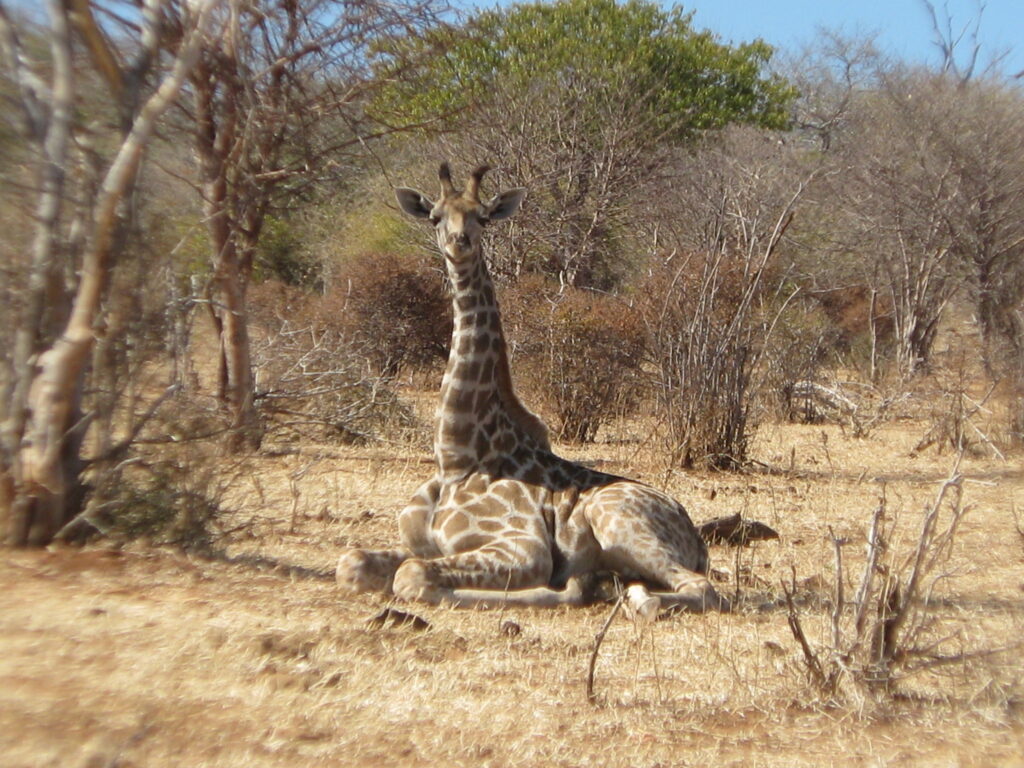
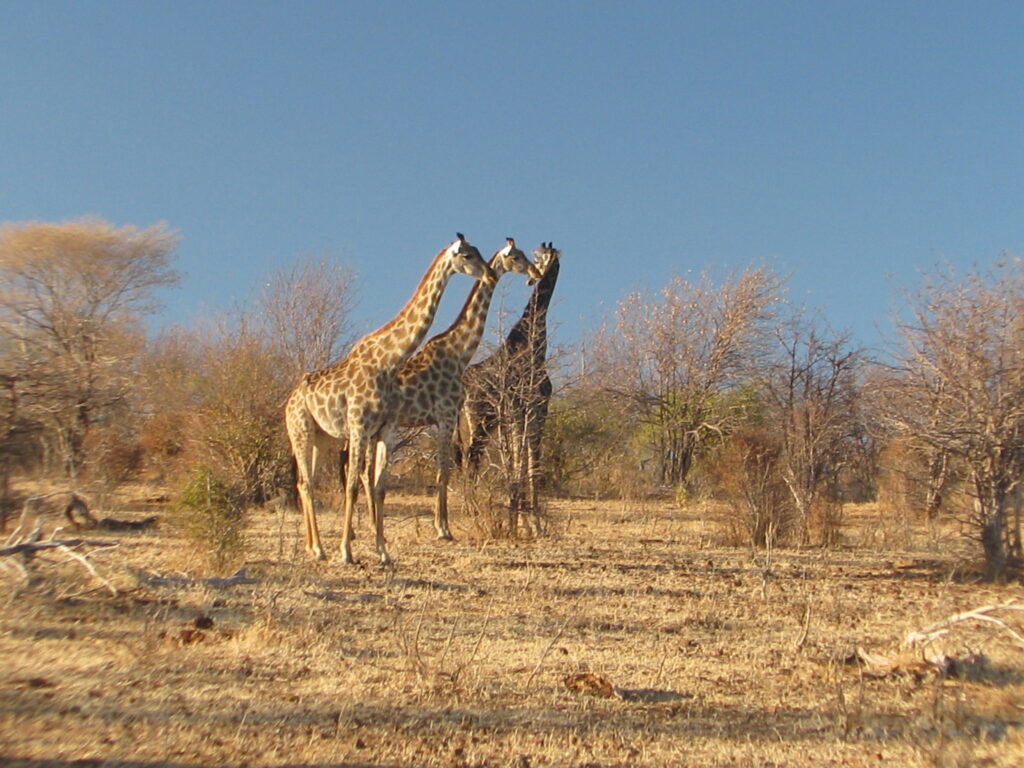
#2. Southern Giraffe. My second highlight is also one of my favorite animals to watch because of their unique and awkward physical appearance, which can make for some interesting maneuvers – as you shall see. This species is the epitomy of evolution by natural selection. What a crazy body form! Only evolution could create such a creature, who is perfectly adapted to browse on all the yummy vegetation that is out of reach to all those other “lowly” herbivores. As such, with its outstretch neck, the giraffe has access to an essentially untapped food resource. Of course, it comes at the expense of some pretty big tradeoffs. It makes it a bit awkward to run at high speeds, so the best they can do is lollop along. And they do so with the very unique gate of the front and rear legs both moving at the same time, alternating with the two legs on the other side – unlike most 4-legged creatures in which the front right and rear left come forward together followed by the front left and rear right. So they look really wierd when running

Now, we an all agree that the neck of the giraffe is exceptionally long. So how many cervical (neck) vertebrate do you think they have? Hint: we humans have 7. So, it must be like 20 or 30, right? Actually, no, they also have only 7 cervical vertebrate – they are just super elongated ones. This means they can’t articulate their neck as much as you think they might like to. And with regards to the neck, one of the fun things you will see in the video is these 2 young bulls “necking” – no that doesn’t mean they are having sexual relations – it is how they battle. These two young bulls are just trying out their combat skills, sort of practicing if you will, before they have to really use their necking skills to compete for the pleasure of mating with receptive females.

Another tradeoff of being so tall is that it makes it very difficult to get your head down to the water hole to get a drink. So, they have to splay their frong legs apart so as to lower their body just enough to get their head down to the water. This makes for a very awkward posture, and one they are not keen to make often as they are vulnerable to lion predation at this time. In the video, note the tentativeness at getting low for the drink. But alas, it has to be done!

Lastly, while the southern giraffe once enjoyed a nearly ubiquitous distribution throughout sud-Saharan Africa, they too have had their distribution drastically reduced by humans. Fortunately, this species of giraffe still has pretty substantial numbers in southern Africa, albeit restricted mostly to the Parks and Reserves. OK, enjoy this video of a few of my favorit giraffe moments in Kruger:

Giraffe composite video (4 minutes)

#3. Wild dogs. Let’s finish with one of my best experiences in Kruger. On my second to last day in the Park I came across this pack of wild dogs in the road. I had this drive entirely to myself as I hadn’t seen another vehicle all morning – hoorah! I won’t say too much here because I had the good sense of doing a little narration in the video itself and I covered some of the key points of interest. Suffice it to say that this observational experience was exceptional on many levels. First, because it was with wild dogs, which are one of Africa’s coolest predators, and second, because I spent perhaps 1 hour with these dogs all by myself, something that is rare in the Parks when sighting a predator species like this. In case you were wondering, this is why I am in Africa!

Wild dog composite video (8 minutes)

I hope you enjoyed some of these Kruger highlights. There’s lots more to share with you on some other pretty cool species and observations, including some more mystery sounts, but I think I will leave those for later as this post is already rediculously long. So long Kruger – Cheers!

May 20-21: Kruger Moments

After a couple nights in the big city, I moved north to the small city of Satara. If my first Kruger campground (Skukusa) was New York City, my new campground is perhaps Philadelphia. Still a rather big “city” for a campground, but I was able to find a little corner in the campground to nestle my Green Dragon into that wasn’t too bad.

The landscape surrounding this section of the Park differs somewhat from the southern section around Skukusa. In the vicinity of my campsite it is a rather vast open savannah grassland with scattered low scrub and the ocassional tree.

To the east again are the low, arid rhyolite hills of the Lebombo Mountains which run the length of the Park.

To the north the open svannah starts to grade into into mopane woodlands (i.e., less grass, more trees) on basalt soils, and the woodlands get denser in the riparian zones along the major river courses.

Like the marula woodlands to the south, the mopane woodlands warrant some attention as well. These woodlands are widespread in lower-lying areas of eastern southern Africa and are generally found on lower elevation drier sights than the marula woodlands, but what is most distinctive of these woodlands is that thye are comprised almost exclusively of a single tree species – mopane. The mopane tree is easily distinguished by its butterfly-shaped leaves. Mopane wood is extremely hard and prized as firewood and building material by the locals. In addition, the mopane leaves are eaten by an enormous variety of wildlife species. The mopane “worm” is the caterpillar form of the Emperor moth, which lives nearly its entire life on the mopane tree. Interestingly, mopane worms are a staple part of the diet in many rural areas and are considered a delicacy in the cities. They can be eaten dry, as crunchy as potato chips, or cooked and drenched in sauce – I tried a dried one once and it tasted like I was eating tree bark, yuck! Most importantly, the worms are high in healthy nutrients and contain three times the amount of protein as beef. Yes, that’s right, three times the protein content as beef. Can you imagine the positive environmental consequences of producing mopane words instead of beef?

OK, enough educational material. Let’s start with a mystery soundtract. Hint, this is a creatures you probably don’t want to run into on foot:

If you guessed lion, you’re right! This is one of the quintessential nightime sounds in Africa and it can send shivers up your spine if you’re sleeping outside on the ground – Rick, buddy, if you’re listening, I’m sorry if this brings back your nightmares.

Here is another mystery soundtract that gives some the creepy crawlies:

If you guessed spotted hyeana, you’re right! This is another one of those classic, nerve-tingling, nightime sounds in Africa. More often than not, when you hear these guys at night you can almost bet that while you’re asleep they will be quitely roaming through your campsite looking for stuff to eat and/or steal. They may even try to play the guitar with their teeth if you accidentally leave it outside your tent.

I recorded both of these critters while lying atop the Green Dragon after dark, and I have had these nocturnal audio visitors every night since being in the Park. I have also seen both critters. I watched lions mating – out of respect I did not photograph the act – and drove along side a pack of hyeanas leaving camp early one morning:

Spotte hyeana

Time for some anectdotal wildlife observations from the last few days in Kruger:

#1. Green Dragon staredown against the largest land animal on the planet:

Elephant staredown

In case you were wondering, I parked on the road quite some distance from the herd and they approached me of their own accord. The matriarch of the herd came between me and her family as they crossed in front on their way to the river and she stared me down assessing whether I represented any threat. She was quickly joined by one of the younger females in the unit and eventually she decided the Green Dragon was OK.

#2. Harem scarem:

Horny male impala

This male impala has gathered a huge harem (one of the largest I have ever seen) and as you can see he is very busy trying to cover any poor girl that is coming into estrous – and that’s a lot of gals. Note, there are dozens and dozens of bachalor males out on the periphery of the harem, all waiting for the opportunity to sneak in and have a go with one of the gals. Between chasing off the relentless challengers and trying to “cover” the gals in heat, I don’t know how he has time to eat and sleep.

#3. Delicate beauty:

Impala (female)

The impala may be the most abundant and ubiquitous antelope in all of sub-Saharan Africa, probably representing more antelope biomass than all of the other antelope species combined, but that doesn’t detract from their delicate beauty.

#4. Bath time:

Cape buffalo mud bath

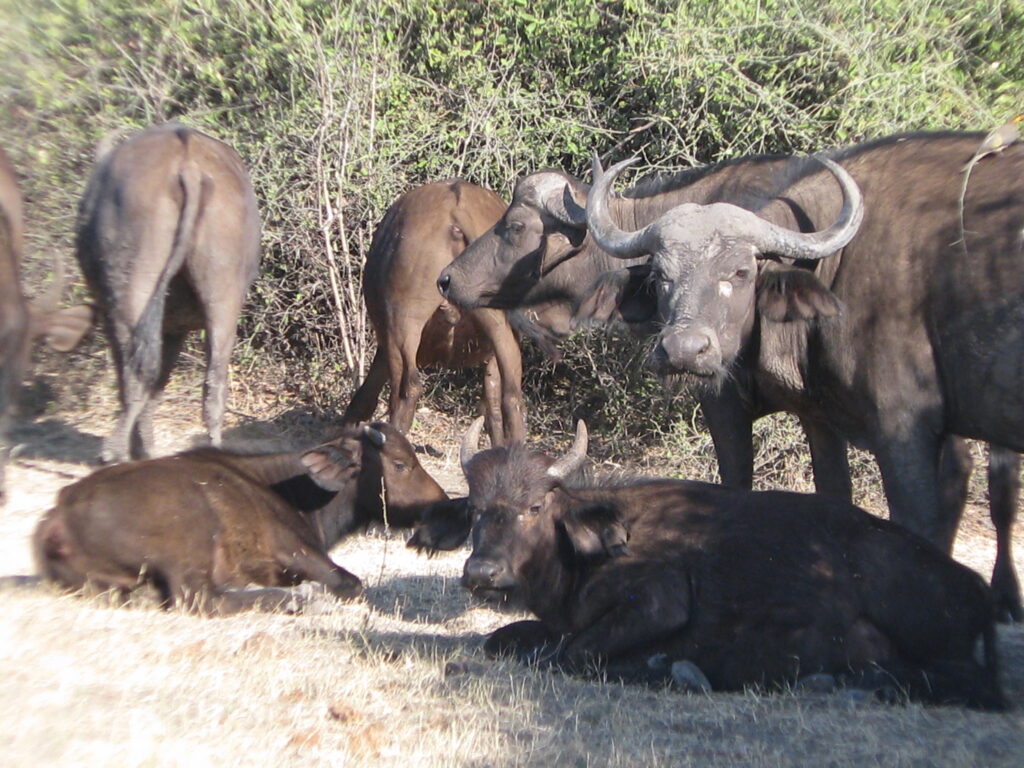
This big boy Cape buffalo just got up from his mud bath and looked at me like I had just ruined his very expensive spa. Sorry!

These next several observations are primarily for Skylar – and those of you that are really, really young at heart.

#1. Who is hiding behind this tree playing “Gander Boo” with me?

#2. What shape does this waterbuck (girl) have on its butt?

#3. How many antelope are napping?

#4. How many zebra do you see in this picture?

#5. This mommy and daddy are teaching their babies how to find food for themselves – how many babies do you see?

Natal spurfowl family foraging

And to finish this post, I am going show you a few other species that I managed to get a usable but not great picture of:

Lilac-breasted roller
Blue wildebeest
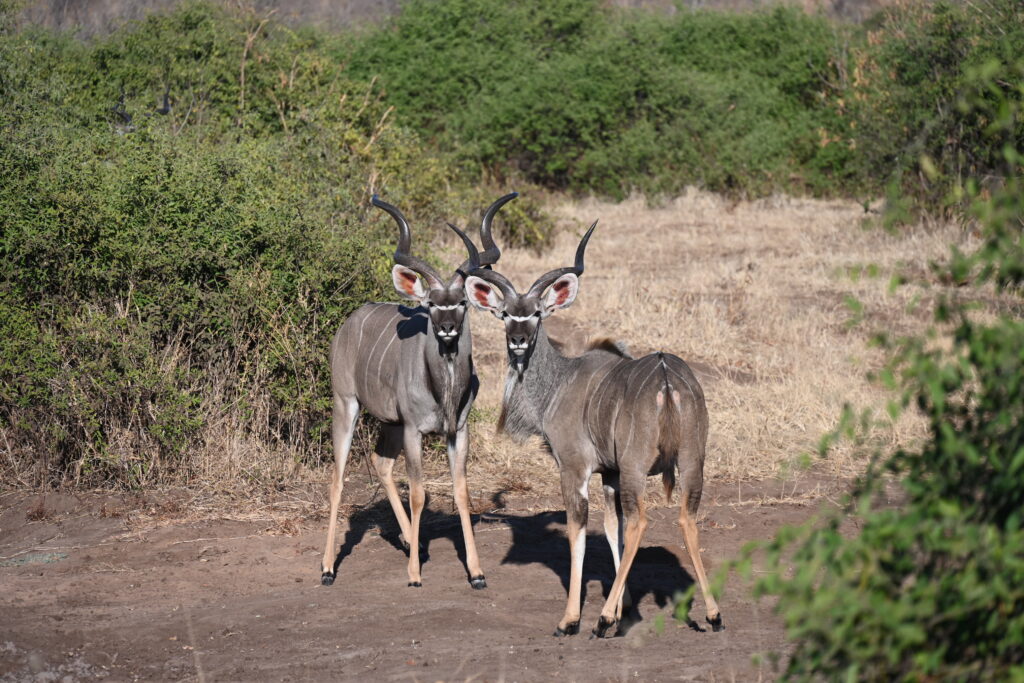
Lesser kudo
Saddle-billed stork
Black-backed jackel

OK, the lions are roaring again, time for me to say goodnight!

May 19: Kruger City

Don’t worry, at some point I will have nothing new to share each day and I won’t be posting every day, but for now…

Let’s get the ugly out of the way first. The National Park campground I am in right now is more of a city than a campground. There are hundreds of rondavels, chalets, and luxury accommodations at all price levels, restaurants, fuel stations, shopping center, fitness spa, and more. And all within an electric fence so that the kids running around here don’t get snatched up by the lions and hyenas, both of which I heard last night just outside the compound. This compound must be a hundre acres or more and the “camper’s” section is an area within the compound that accommodates perhaps 100 campers, almost all in camper RVs of some sort, packed together so that you hear and mostly see everything going on with your neighbors. There is nothing like this in the States. Even the most upscale KOA campground pales in comparison to this. As you might have guessed by now – this is not my cup of tea, but I don’t have a choice if I want to camp inside the Park. Despite this, I was able to nestle the Green Dragon in a little cubby surrounded by bushes on 2 sides:

On the positive side, my immediate neighbors (to the left of me in the picture above) are a nice, older South African couple from Cape Town – and they’re quiet too!

OK, I am going to share with you another meal I prepared, just to make you a little envious. Tonight, well, actually this afternoon between my morning drive and evening drive, I cooked up another stir fry. This time, I started with the usual chopped potatoe and onion in olive oil base, added some kale (got to get in those “greens” at every opportunity) and tomatoes, and smothered it with a garlic parmesan sauce – yum, yum! By the way, I probably won’t show you many more camp meals in the blog because they are all pretty much variations on the same theme: stir fry various vegetables and add a sauce of some sort. Sometimes the base is a pasta or rice instead of the usual potatoe/onion, but in the end it all comes out about the same – delicious!

Now for some fun anecdotal wildlife observations from today.

“Hey Joe, if we can’t see them, they can’t see us, right?”

Chacma baboon

Do you see the lions up on that hill?

Rocky hill on the plain, otherwise known as a “Koppie”

Neither do I, but it would be a good place to hang out and scan for prey.

“Has anyone seen my harem, I thought I left them over there”

Impala

“Nope, there not over there either!”

“Or over there! Where the hell are they?”

“Dang, and I spent all that time and energy rounding them up.”

“Oh, wait, there they are! Thank goodness!”

“I don’t know why all those safari guides keep throwing sticks at me, I just want a little food”

Vervet monkey

Hide-and-seek is really hard when your this big!

African elephant

OK, enough of that silly business. Here is today’s wildlife observation challenge for you. Who is living in this termite mound?

Right, this is a colony of mongooses – the common dwarf mongoose to be specific. These guys live in colonies of 10-20 individuals and occupy old termite mounds for their home. In the mornings they like to come out of the tunnels and bask in the sun – which we are seeing here.

Here is a mystery sound for you. However, you folks that have been to Africa before should get this one:

If you guessed some kind of gull I wouldn’t be suprised because that is what I thought when I first heard the African fish eagle.

And now for the species of the day. There are lots to choose from as I saw lots of new species today, but I am going to go with the African Hoopoe. This is one cool looking bird with his orange and black mohawk. When you see a bird like this you understand why birding is such fun and why so many people take up the hobby. This guy is dressed to kill but nevertheless loves to forage around on the ground for insects. Also, they nest in tree cavities made by other species.

See you next time.

May 18: Welcome to Kruger

WARNING – this post is a long one as I have a lot to report on given it’s my first day in Kruger National Park.

By the way, I finally was able to upload the videos of the Green Dragon in case you are interested – see the Vehicle page on this website.

Before introducing Kruger and showing you some fun wildlife observations, I want to share one unrelated observation. The southeastern entrance to Kruger where I was entering the Park is very close to the Mozambique border. Due to the inefficiency of the border post, the coal trucks on the South African side of the border on the major highway I was traveling on were backed up in a line that extended at least 10 miles, I kid you not. At the pace they were moving it would take several days, at least, for a truck to get across the border. Why they are moving all this coal via truck and not train, when there is a track along this route, is beyond me. Fortunately, I was able to simply skirt around the procession and proceed on my way.

Ok, let’s introduce the iconic Kruger National Park, the flagship Park of South Africa located in the northeastern corner of the country bordering Mozambique and Zimbabwe. Kruger NP (7,576 sq mi), established in 1926, is both the 1st national park established in South Africa as well as the largest in the country, and the 6th largest national park across the entire continent of Africa. The Park is elongated north to south – extending 220 miles from north to south along the western slopes of the narrow Lubombo Mountain chain which forms the border with Mozambique and running 40 miles from east to west, on average, along its length. As a consequence of Kruger’s latitudinal and elevational gradients and varied soils derived from mostly igneous (of volcanic origin) materials, the Park supports a wide range of ecosystems and varied habitats for an exceptional array of wildlife. Kruger is an important stronghold for several of Africa’s most iconic large mammals, including supporting more than half the world’s remaining white rhinos, along with substantial populations of giraffes, buffaloes, elephants, black rhinos, leopards, cheetahs, African wild dogs and, of course, lions.

My first public campsite in Kruger is Skukuza, located in the southern section of the Park along the banks of the perennial Sabie River. The landscape surrounding this section of the Park is highly varied. To the east are the low, arid rhyolite hills of the Lebombo Mountains. The soils of the Lebombo are shallow and stony, and as this is one of the driest parts of Kruger, it is dominated by drought-resistant plants.

Lying west of the Lebombo hills is a rather vast open savannah grassland on basalt soils (dark, fine-grained igneous rock rich in magnesium and iron derived from extrusive molten lava). These savannah grasslands contain scattered acacia trees and form the classic picture of the African savannah.

Further to the west in the vicinity of my campsite at Skukuza are areas of mixed thorn thickets and marula woodlands on granite soils (lighter, coarse-grained igneous rock rich in quartz and feldspar, also derived from extrusive molten lava).

The marula tree is worth describing in more detail, as it is important for its commercial and wildlife uses, and it is an important member of what is referred to as miombo woodlands, which are the most extensive tropical seasonal woodland and dry forest formation in Africa. Miombo is found throughout west, central and east Africa and extends southward just barely into South Africa. Marula is a medium-sized deciduous fruit-bearing tree, indigenous to the miombo woodlands of Southern Africa, and it has a beautiful spreading crown.

Some cool facts about the Marula tree: The marula fruit is used to make a beer and liqueur, and is used in fruit juice blends – it is sky-high in Vitamin C. In addition, the extracted nut oil is similar in its properties to olive oil, highly nutritious and exceptionally stable, with the additional benefit of having powerful antioxidant properties, and it is used as an ingredient in cosmetics (e.g., moisturizers). Locals believe it is known as “The Marriage Tree” in Zulu culture, as it is believed that those who marry beneath its branches will enjoy vigour and fertility all their days. And of course, the fruit is eaten by many wildlife species and is a favorite of elephants. Interestingly, elephants damage the trees by eating the bark and can even kill the trees by girdling, but at the same time are an important disperser of the seeds which they spread in their dung.

Ok, that’s enough on the environment of Kruger south, let’s see some wildlife. Here are some anecdotal wildlife observations from today:

Peek-a-boo, I see you!

Do you see the Rhino in the bushes?

Whoops, it’s just a rock!

Let’s all cross in an orderly fasion please:

Watch out for that bison crossing the road – I mean Cape Buffalo!

Shake that booty!

Tuppens for the poor?

Skylar are you watching: “mommy elephant, big girl elephant, little girl elephant, and baby elephant”

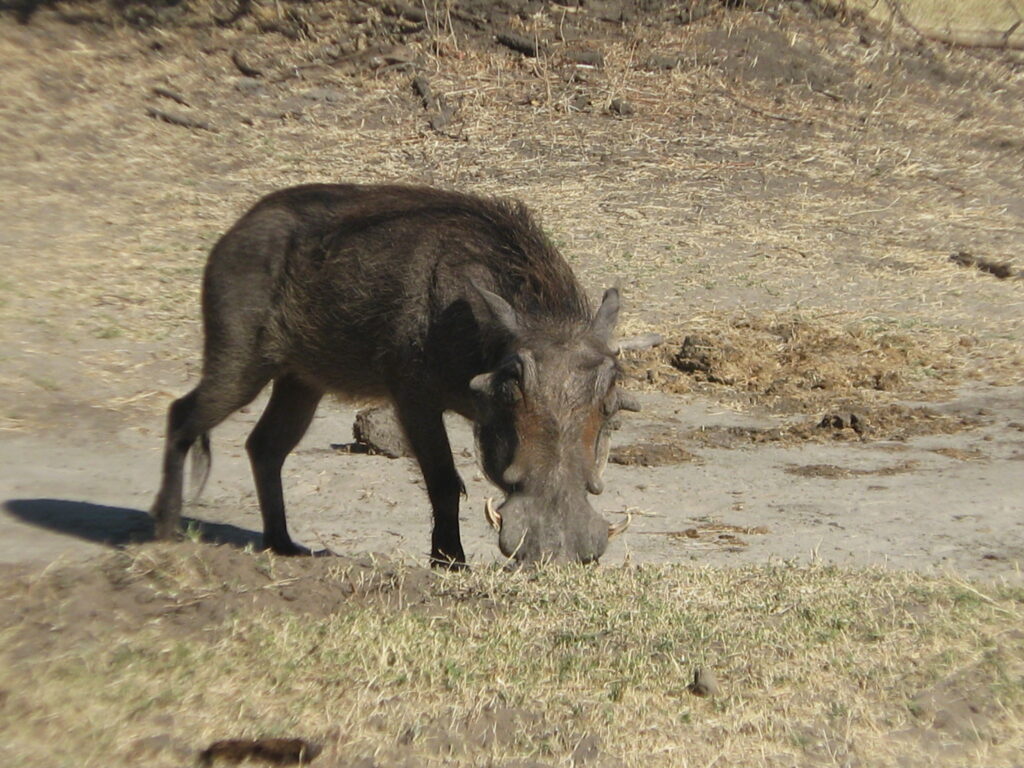
And last but not least, the species of the day – this one’s for you Sherry – is the warthog. Now how could you not love and admire this pig. They eat just about anything and everything, they live in just about any habitat in sub-saharan Africa, they run around in little matriarcal groups called “sounders” – and with their tails held high, they like to roll around in the mud to keep cool, they can burst at speeds of up to 30 mph to escape predators, and they can use their formidable tusks to defend themselves against predators such as lions, leopards and hyena’s.

Time for bed. Goodnight all!

May 17: Daily Life

Before delving in the topic of daily life, I want to share a revelation I had today while driving. You recall the roads from hell on the 4 hour bypass from hell yesterday, well, today I had an epiphony regarding the road maintenance issue (or lack thereof) in South Africa after passing yet another of these road signs:

Instead of actually fixing the potholes, let’s just put up a sign warning drivers of upcoming potholes. Brilliant! Why didn’t I think of that? The government bureaucrat that came up with this strategy was probably promoted to head of the Department of Transportation for saving the government millions on road maintenance. No one can say they aren’t doing something about the issue. Do you think we should propose this in the States?

OK, now on to business. I have had a few requests to share more of the practical aspects of my daily life on the road with the Green Dragon, so here’s a few tidbits – but not too much, lest most readers will fall asleep and miss the species of the day.

You will recall from yesterday’s post that I got to my private little lakeside campsite in the dark and thus wasn’t able to show you my setup. First, here is what I woke up to:

After listening to my morning serenade from the local avifauna – what a way to wake up – I took a few shots of my campsite as promised:

Note, that building beside the Green Dragon is a restroom and hot shower, along with a little outdoor kitchen. My typical breakfast is a bowl of oatmeal with mixed nuts and dried fruit (usually raisins) – it’s super heart healthy and quick to prepare! However, on occasion I go Full Monty and prepare a scrumptious meal. Today, in my cast iron cookpot on my diesel (yes, diesel) cook stove I started with some olive oil, then put in a chopped yellow potatoe, then a chopped sweet potatoe and yellow onion, with a little tamari and salt and pepper, followed by a chopped green peppper and tomatoe, and topped with a few slices of vegan (yeah, I know) cheese. Here’s the preparation and final result:

Delicous! And I have enough for tomorrow as well. So, don’t think I am starving myself or eating simple quick meals. I spare nothing when it comes to good food when I am camping.

I really hated to leave my private lakeside campsite for $3 a night, but given yesterdays travel experience I thought it wise to drive most of the way to Kruger National Park today so that I can for sure get to my first Kruger campsite tomorrow with time to spare. I don’t have landscape pictures of the drive because it was pretty much Iowa again, with the addition of a big coal mine or two. So we can sum up the landscape as Corn, Cows and Coal (CCC). The one thing I will share as an adendum to my previous post on the “shanty towns” is that today I didn’t see any of these camps. Instead, I saw a few townships with government housing – for the “black” South Africans I assume – that are a vast improvement over the camps I saw in the Cape Provinces:

My campsite tonight is another little hidden gem that I discovered on iOverlander that puts me about an hour or two drive from my entrance to Kruger National Park in the middle of macademia nut county – acres and acres of macademia trees and a huge processing factory just across the river from here. If you eat macademia nuts, there’s a very good chance this is where they were grown. These hidden sites are truly amazing. You drive down a bumpy dirt road that looks like it’s going nowhere and then you go through a locked gate and, Shazam, you enter a new world. This place turns out to be a really nice lodge with riverside chalets or cabins, restaurant for the guests, and a Park-like area for campers like me. As you can see from the photo below, the camping area is a pleasant grassy patch with nice shade trees. And, get this, I have my own private ablution facility with the full works, including hot shower. All this for roughly $13!

There is just one other couple camping here so it is quite serene.

It’s time for species of the day. This morning at my private lakeside campsite on the hillside above my camp there were a few Blesbok, so I can count this as the species of the day. However, I managed to get a better photo at Mountain Zebra National Park so that’s the picture I will share below. I chose this species in part because they are pretty cool looking, but also because I probably won’t see them again as their range is quite small and restricted to the east-central plains of South Africa. This is one of the antelop species whose range has been severly reduced to the few National Parks and some game farms. This is a rather large antelope – think elk size – with a very distinctive and striking color pattern that makes them rather easy to spot. They feed primarily on grasses so you find them almost exclusively in the open grasslands and they usually occur in small herds of a few to a couple dozen, although in the winter they can come together in much larger herds. I saw plenty of these guys at Mountain Zebra and Golden Gate Highlands National Parks.

Next stop, Kruger National Park.

May 16: TIA madness!

Not too much to report today other than I had a real TIA (“This is Africa”) day today, and here’s why. After a wonderful stay at Golden Gate Highlands National Park, I hit the road to get halfway to my next destination – the famous Kruger National Park. What started out as an absolutely gorgeous day with an expected drive time of about 5-6 hours and arrival at my chosen iOverlander campsite on the shores of Lake Chrissiesmeer turned out to be an 11 hour drive with arrival to my campsite after dark – which I really hate!

With the start of the trip, all was going well. Leaving the Park, I drove through Maluti-Drakensberg mountains during an awesome sunrise on the rocks and outcrops, and then began a long haul northeasterly across the rolling hills of the northeastern part of the Free State province and the southwestern part of the Mpumalanga province. This part of the country can be summed up in two words: corn & cattle, with the former dominating the landscape. If it weren’t for the not-so-flat terrain I could easily have thought I was driving across Iowa. Then, just when I was about 2 hours from my destination there was an unannounced road block. Turns out the town up ahead was protesting something (don’t know what) and had blocked the road and were not letting anyone through. Note, this was a fairly significant highway and long-haul route for truckers, so there were dozens of them stopped on the roadway. My navigation system could not handle this at all and would not, could not, direct me to an alternate route. So, I did the next best thing and spoke to a police officer who directed me to take this dirt road for 10 km, and then turn right, and when you get to ?? turn left, and then at the ?? sign turn right, and follow that for xx km until you see ?? You get the point! To my good (turns out perhaps not so good) fortune, another native in a small transit truck was trying to get to the same place (or the nearby town) and he too spoke to the police officer and decided to go for it. He was super nice and asked if I wanted to follow, so I did.

After a few kilometes on this dirt road we ran into this, and I thought this might turn out to be an interesting little bypass adventure a way to see the “real Africa”:

After 10 km more of dirt road that turn out to be muddy (which messed up my beautiful car wash I just had done a few hours earlier) we hit a paved road and all was looking good, except that we were now headed in exactly the opposite direction of my destination. Have faith I told myself. Of course, to reinforce my doubts, my navigation systems (two of them no less!) were screaming at me to turn around, and they kept on screaming at me every couple of minutes until I could turn them off. However, it took me an hour or two to turn them off because I was fully occupied trying to keep up with my South African guide and I literally couldn’t take my hands off the wheel or my eyes off the road. Why, you might ask. Well, imagine what a road would look like after being cluster bombed. That’s what this “highway” was like. Potholes all over the place. And these were foot-deep potholes, not your average American pothole. Driving was essentially an obstacle course, and at speed too so as to keep up with my guide. This went on for perhaps 2 hours – but I continued to have faith in my native savior believe it or not. This was not the worst of it. When we finally did turn onto a new road and the tarmak appeared to be in good shape, we would pick up speed and be cruising along when suddenly, without warning, there would be a massive pothole. I can’t tell you how many times I swore during these random potholle episodes, but let’s just say I am glad Skylar wasn’t in the car.

Eventually, 11 hours later, I did make it to my destination, but after dark. Fortunately, there is a happy ending to this story. Remember, this campsite is not on any real map per se, but instead is listed on my iOverlander App. Have faith in the App I always tell myself, and it hasn’t disappointed yet. Driving down a dirt road several kilometers I turned into what looked like a driveway to a farm, but eventually I came to a gate with a house off a little in the distance. To my good fortune the owner came out and opened the electronic gate remotely. I drove through and got the green light to continue down this farmyard track towards the lake, which I did. I eventually got to a “keepers” house who welcomed me to, yes, an actual campsite. After paying about 3 USD for a night stay (yes, that’s 3 US dollars) she got on her ATV and led me across a field and down a track to an incredible lake-side camping spot with full ablution facilities (that’s restroom, kitchen sink, shower, etc.). And to top it off, I am the only one here – jackpot. So, there is reward at the end of the rainbow!

I’ll show you the campsite tomorrow when it is light. Goodnight!

May 15: Golden Gate Highlands National Park

As per my previous post, I arrived at my destination Park last night. I spent today exploring Golden Gate Highlands National Park, located near the town of Bethlehem and on the northern edge of the embedded country of Lesotho. Golden Gate NP (130 sq mi), established in 1963 to protect the sandstone shelters that once served as shelters for the indigenous San people (a.k.a. “Bushman”), lies in the rolling foothills on the northern end of the Maluti-Drakensberg Mountains. The landscape consists mainly of wooded ravines, gullies and highland grasslands (or grassland veld as they call it). The park’s most notable features are its golden, ochre, and orange-hued, deeply eroded sandstone cliffs and outcrops that shine golden-yellow in the setting sun, from which the Park derives its name. I did my best to capture this scene in the following photos:

Although the rock cliffs and outcrops are the flagship features of the Park, the Park is actually most important for its conservation of high elevation grassland veld. As this series of photos depict, the mountains and valleys are covered by grassland, with something like 40 different grass species making up the mix. It is truly remarkable to see grasslands extend from the valley bottom up over the tallest mountains, some of which climb over 10,000 ft in elevation.

Another notable feature of the Park is the numerous caves and shelters displaying San rock paintings, which I was not able to see. The San were popularized, you might recall, in the movie “The Gods Must be Crazy”. The San are part of a larger ethnic group of herders (Khoi) and hunter-gatherers (San) in southern Africa known as Khoisan, which as recently as 22,000 years ago apparently constituted the largest group of humans on earth. Unfortunately, like most indigenous groups in Africa and elsewhere, the Khoisan were dispossesed of land and gradually displaced and/or assimilated by more “advanced” cultures – in this case, first by the southward immigration of Bantu-speaking agriculturalists around 2,000 years ago, and eventually by European colonists, primarily Dutch (known as the Boers) beginning in the mid 17th century and finally the British who took over from the Dutch in the early 19th century after a bloody war (known as the Boer war). As with many indigenous peoples, small pox decimated the Khoisan and Bantu after contact with European colonists, and many local populations were exterminated or enslaved by the technologically more advanced European colonists. Interestingly, following the end of Apartheid in 1994, the term “Khoisan” has gradually come to be used as a self-designation by ethnic South Africans as representing the “first nations” of South Africa vis-a-vis the ruling Bantu majority, and there has been an uprising of “Khoisan activism” in recent years, with ardent calls to restore ancestral land claims. I wish them the best of luck in their uphill endeavor.

The Park is also notable as one of the last refuges in all of Africa of the rare bearded vulture (also known as the lammergeier and ossifrage) and the southern bald ibis, as well as the rare oribi (a small, slender species of antelope). Alas, I did not see any of these species today despite my efforts, but these was not surprising given how rare they are and the time of year – regardless, it’s nice to know they are here. I just have to show you a picture of the head of the bearded vulture that I borrowed from the internet – so cool:

My public campsite is Glen Reenen rest camp in the Park. It’s a pretty awesome setting as I hope these photos capture:

I know this post is getting long, but I have to share some details and photos of the 4 hour hike I did this morning becuase it was challenging and rewarding on many levels. Basically I climbed 3,000 ft up above the escarpment to the high ridge above the campsite and then traversed the ridge for a couple of miles and then descended to below the escarpment and traverse the base of it back to the beginning. I started in beautiful sunny weather with a few broken clouds but by the time I got above the escarpment the wind was howling and I was engulfed in rain clouds. Visibility was very poor at times, but then it would break a little and I would get spectacular views only to be socked in again a minute later. I was the only person on the trail – sublime! Here are some shots of the hike that make it look more tame than it actually was – honest. Note, the first picture shows the central part of the ridge I traversed way up above the campsite:

OK, enough is enough, it’s time for, you guessed it, species of the day. Today I am dedicating this choice to my granddaughter Skylar, and she will know why is just a second. The species is the Chacma Baboon, which most will be somewhat familiar with. While these guys can be a real nuisance around the campsite – stealing anything not tied down or that weighs less than about 50 pounds, edible or not – they have a remarkable social structure. They usually live in troops that vary is size, but usually have dozens of individuals, including a dominant male, several subordinate males, lots of females and young ones. And it is to this last item that I bring your attention Skylar. The picture below is of a mommy and baby! Indeed, this little guy couldn’t be more than a few days old. Mom was so intent on letting her little baby nurse that she wouldn’t even move off the road, forcing me and other vehicles to skirt around her. Now that’s a nurturing mommy!

Hope you liked that one Skylar. Tomorrow, on the road again. Cheers.

May 14: Happy Mother’s Day!

First and foremost, happy mother’s day to all you mothers out there!

Second, today was a rather grueling long haul day driving from Mountain Zebra National Park 9 hours (argh) northeast up to Golden Gate Highlands National Park. As depicted in the map above, my original plan was to go to Mokala National Park for a couple of nights on the way to Golden Gate, but since I spent a few more days in Cape Town than originally expected, I had to cut out Mokala – bummer. Anyways, I am going to save my overview of this Park until tomorrow after I have seen the Park and am able to share photos and stories, etc. For now, let me share a few observations, photos and sounds of the day.

Shortly after leaving Mountain Zebra National Park heading in a northeast direction I left the Eastern Cape Province and entered the Freestate Province and started encountering immense cattle and sheep ranches – albeit with very few head of livestock. Nothing like the intensive livestock densities we see on similar productive grasslands in the states. Based on the fencing, these ranches must be ’10s’ of thousands of acres each, if not more – and I can ony imaging how these vast land holdings were acquired from the indigenous peoples back during the great trek north from Cape Town by the pioneer white dutch-descendent “voortrekkers” as they were called, or the Brittish settlers who came along behind them. The landscape was nothing spectacular, just vast grass-covered plains and scattered hills:

As I headed northeast further into the Free State, land productivity apparently increased and I started seeing vast fields of mostly corn, but some sorghum (I think) as well, and increasing homesites. I could have easily been driving through Iowa had I not seen the mountains in the distance:

OK, enough of the somewhat boring landscape from today. The species of the species of the day is the Springbok which I have seen a plenty. Despite their abundance and ubiquity in southern Africa they are nonetheless a very cool species – and beautiful too! As you can see from the picture I took below, they in some ways resemble our North American pronghorn antelope. Like the pronghorn, the springbok is also an antelope of the semi-desert environment and can survive for very long periods without drinking any water. Instead, it can derive much of its water needs from the food it eats when surface water is not available. Consequently, it occupies habitats that are much too dry for many of the other antelope species that we will encounter. This species likes open expanses of grassland and perhaps some scattered shrubs, but you don’t find them when the shrub cover gets too great or in woodlands because they would too easily fall prey to leapords and lions. Instead, a major predator they have to be on the look for in their preferred open country is the cheetah – the fast land animal on Earth. I often see springbok in small groups of bachelors but other times I see large herds of 20-50 or more containing adults and young. The young ones especially love to “play” by chasing each other around, and both the young and adults like to “pronk”, or run and jump in the air with arched back and stiff legs. They are really fun to watch!

OK, here is the mystery sound for today that I just recorded while lying in my roof-top bed in the public campsite at Golden Gate Highlands National Park. Can you guess what it is?

mystery sounds

Well, if you guessed Coyote you are not far from the mark. This is the call of the Black-backed jackal, which is close to being the ecological counterpart of the Coyote here in Africa. Here is a picture I stole from the internet so that you can see what the critter looks like:

Until next time, sleep tight and don’t let the jackals bite!

May 12-13: On to Mountain Zebra

My next stop after leaving Karoo National Park was going to be Camdeboo National Park, but when I arrived it was totally socked in with clouds, and the forecast was for likely rain over the next few days. The primary attraction and why I planned to visit the Park is its huge dolerite pillars, some of which are 120 meters high, located in the “Valley of Desolation”. Note, dolerite is an igneous rock (i.e., rock initially molten and injected as a fluid into older sedimentary rocks); thus, it stands in stark contrast to the surrounding layered sedimentary rocks. The Valley of Desolation is purported to be quite spectacular. However, the weather would have prevented me from seeing anything so I opted to continue on – major bummer!

On my way to my next destination, I continued travelling across the Great Karoo for several hours. One of the things I find fascination about the natural world are ecological convergences; that is, ecological systems and/or environments that evolve over time to be very similar in terms of their physical environment and their flora and fauna, despite being geographically isolated. In these convergent ecosystems, the plant and animal speciers are totally different yet perform the same or very similar ecological functions. I mention this because driving across the Karoo reminds me in so many ways of driving through parts of western North America. There are extensive semi-arid plains that go on for as far as the eye can see, reminding me of the non-irrigated western great plains – I could easly believe I was driving through parts of Nebraska or Kansas, as shown here:

These plains are regularly broken up by grass and shrub-covered hills, mesa-like landforms and mountains proper, reminding me of parts of the inner mountain west – I could easily believe I was driving through parts of Idaho or Utah, as these photos depict:

One of the biggest surprises for me regarding this part of South Africa is that I came with the preconceived notion that most of this part of the country was populated (by humans, that is) and in some form of productive agriculture, whether that be cultivated or pastoral land use. Instead, this landscape (the Karoo, that is) is almost completed unpopulated and wild, even though it is almost entirely private land. I belive what I am looking at are immense ranches (mostly just a few sheep herds, as I have not seen a single cow!!!) and game farms – places where people pay big bucks to go shoot big game animals. If you like wild places with “big sky”, this is clearly a place to visit. After some consideration, I believe the answer lies in the climate, as this area receives less than 20 inches of precipitation a year, which is generally the minimum for cultivation. There is a 20 inch precipitation line that runs north to south that essentially demarcates the western States (Western Cape and North Cape) from the agricultural eastern States (Eastern Cape, Freestate, KwaZulu-Natal).

One last observation on the landscape. The Karoo is vast, as I have said, and once had a relatively abundant megafauna (those large beasts) – albeit at much lower densities than elsewhere – which were largely eliminated by hunting. Today, the megafuana (essentiall all mammals larger than, say, a deer) are almost entirely restricted to the few national parks and game farms (where they are raised as game for hunters). So, the few national parks, such as Karoo, Camdeboo and Mountain Zebra are relics where nature still rules, noting that in these parks several of the larger species (rhino, lion, cheetah, etc.) had to be reintroduced since they had been erradicated. It’s a sad story of human overexploitation not too dissimilar to what was done in North America. These Parks are real lifelines for several of these species.

My destination was Mountain Zebra National Park, located near the town of Cradock. Mountain Zebra NP (110 sq. mi.), established in 1937, is on the eastern edge of the Great Karoo ecosystem; consequently, the vegetation is similar – dominated by grasslands and shrublands, although open- and closed-woodlands are common here in the valley bottoms and prominent rock outcroppings are distinctive as well. Indeed, this area on the eastern side of the Karoo gets a bit more precipitation so the vegetation is more productive. I took the Green Dragon out for a drive through most of the Park, including some 4×4 roads that had mud and some steep rocky/ledgy hill climbs – the Green Dragon performed like a “rock star’. Here is a whole series of pictures that show both the landscape and the drive:

The most notable feature of the Park, and its namesake, is that it is home to the very rare and endangered mountain zebra (I posted a picture of one in my previous post), which will serve as our species of the day. A few decades ago fewer than 20 individuals of this zebra species existed, but since then their numbers have recovered; currently there are more than 350 in the Park and upwards of 5,000 total in the wild. The mountain zebra is distinguished from its more common cousin, the Burchell’s zebra of the plains, by the narrow black and white stripes that extend right down to the hooves (whereas in the Burchell’s the stripes fade down the legs), the grid-iron black and white pattern on the rump, the clear white belly (the stripes do not join under the belly, whereas in the Burchell’s they do), and the longer, more donkey-like ears. In addition, mountain zebras do not aggregate into large herds like plains zebras; instead, they form small family groups consisting of a single stallion and one to five mares, together with their recent offspring. So far, I have been lucky enough to see Mountain Zebra now in three different Parks: Table Mountain (Cape Peninsular), Karoo, and now Mountain Zebra National Park.

OK, for those of you that have read this far (yikes) here are a few observations for you to figure out. First, what critter do you think made this cool dwelling (note, the opening diameter is perhaps 8-10 inches):

Pretty cool little hut, hey. Whoever did it, was a pretty good sculptor as they cared this entrance and tunnel down into an underground sanctuary with their bare hands. You wildlifers, did you guess it? Right, an Aardvark! Unfortunately, you have to out at night to see this guys as they are strictly noctural.

OK, last trivia question. What made this sound?

Mystery sounds

Wildlifers, did you guess it? Sounds a lot like someone we have in North America. It’s a close relative: the Blue Crane! I saw two groups of 4-5 individuals on my drive today and one of the groups had one individual calling and I was able to capture it – yeah!

OK, sory for such a long posting but as you can see I had a lot to say! Next stop, Golden Gate Highlands National Park – and let’s hope it’s not raining all day and night like it has been here.

May 11: Karoo National Park

As mentioned previously, my first National Park after leaving Cape Town is Karoo National Park, located just west of the town of Beaufort West. Karoo NP (297 sq. mi.), established in 1979, is part of the Great Karoo ecosystem, the largest distinct ecosystem in South Africa. It is a vast and unforgiving landscape, yet still home to a fascinating diversity of life, all having adapted to survive in harsh semi-desert conditions. Unfortunately, most of the wildlife that once roamed the Karoo have been eradicated, but the Park is a relatively small area where this unique environment and its animals are protected and persist. This semi-desert area is a sanctuary for herds of springbok, oryx (gemsbok), mountain zebra, buffalo, red hartebeest, black rhinoceros, eland, kudu, klipspringer, bat-eared foxes, black-backed jackal, ostriches, and lions – I saw most of these species today on my drive. It also has the greatest number of tortoise species of any park in the world – five in total! Most of vegetation consists of montane grasslands at the highest elevations where is gets the most precipitation, grading into grassy shrublands and dwarf shrublands at the lower elevations where the precipitation is very low and uncertain, and the occasional riparian thicket along the drainage bottoms – think Sonoran Desert of the American Southwest minus the saguaro cacti and you get a pretty good picture of the environment, as the following pictures try to depict:

My campsite is the public rest camp in the Park. As campsites go, it’s nothing to rave about. I have a small patch of ground surrounded on three sides by thornbushes, but very much within earshot of the other campsites. Modern showers, laundry, kitchen, power hookups, water spickets at every site, etc.. You get the picture. A fairly modern, full amenites campsite. Not the kind of “bush” camping I prefer, but there is no “wild” camping in the South African parks. As an aside, I had some free time this afternoon at my campsite, so I took the opportunity to make a video of the Green Dragon in all its glory . You can check out the vehicle page on this site if you want to see the Dragon in full regalia.

I took a “game” drive today (note, even though it is not really about seeing “game”, which technically refers to hunted species, the locals still refer to these wildlife drives as game drives, so I will go local too) and didn’t see a sole (human, that is) for 5 hours, and then saw maybe 5 vehicles during my last couple of hours. That made for an awesome wildlife viewing exerience that I won’t always have at other more popular safari parks. I saw lots of cool species, including two different species of zebra (mountain zebra and plains zebra) and several different antelope species (gemsbok, springbok, red hartebeest, lesser kudu, mountain reedbuck, and klipspringer) and a dozen or so new bird species. Here are some not-so-great photos I took today of some of these species (note, I have a crappy little camera without a big telephoto lens, so it’s hard for me to get good close-up pictures in focus):

M0untan Zebra
Gemsbok (oryx)
Red hartebeest
Lesser kudu
Springbok (and Gemsbok in back)
Klipspringer (male, note the pointy horns)
Klipspringer (female, had to include this because she is so cute)

My favorite was a stop at a small out-of-the-way little water hole down a 4×4 road, where I sat for perhaps an hour and watched one new bird species after another come to the hole for a drink. Even had a close up of a small grey mongoose on the prowl at the water hole. My camera is not sufficient for photographing birds (except for the occasional ostrich), so I have no bird pictures of my own to share. For you wildlifers out there, especially those that like to list species seen, I created a wildlife species page on this site where I will keep a running list of species seen on this trip. However, for the broader audience, I am going to simply highlight a single cool species I see each day I am in the field.

My species of the day is the Ludwig’s Bustard. This a large cursorial bird adapted for running more than flying. Think chicken-size bird but very long legs and long neck, which they use to run down and catch lizzards, small snakes, rodents and insects of all types. The males also have a throat pouch that they inflate in a spectacular display while strutting around amidst other males in what is called a Lek, all to attract females for the prize of mating. I saw pair of these magnificant birds but wasn’t able to get a photo so I am shamelessly going to borrow a photo off the internet for your benefit:

Ludwig’s bustart (@Albert Froneman)