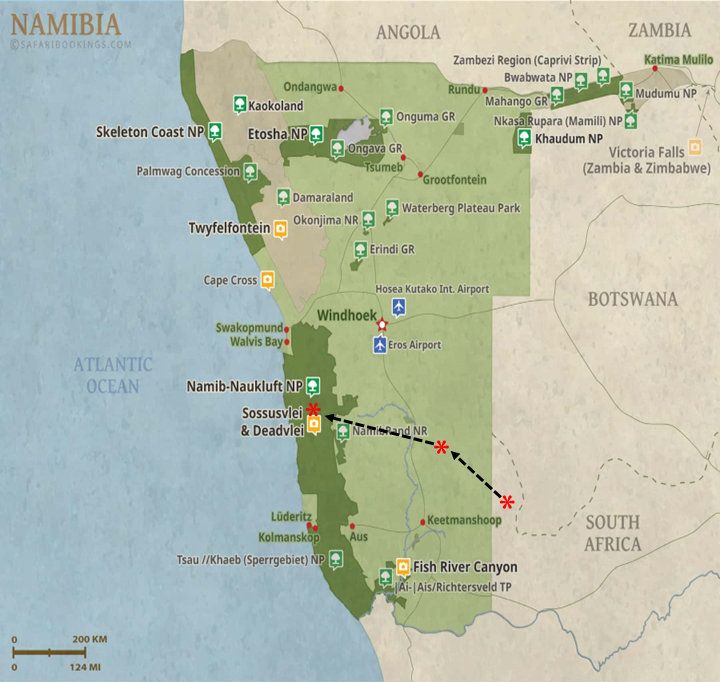
With a bittersweet taste in our mouths, we reluctantly, but excitedly, left the Khalagadi and headed toward Sossusvlei in the Namib Desert but with a one-night stand along the way outside the small town Mariental:
Once again, I refer you to last year’s post on Sossusvlei for more background information along with photos and videos and a slide show.
Sossusvlei blog post 2025: overlandwithkmcgee.com/__trashed-4/
Briefly, Sossusvlei is without question the most iconic place in Namibia, and certainly the most photographed place in the country – for very good reason! Sossusvlei is a large salt pan (something I have talked about before several times in this blog) formed by ephemeral flooding of the Tsauchab River and the accumlation of salts in the clay topsoil. However, the red sand dunes – purported to be some of the, if not THE, highest free-standing dunes in the world – surrounding Sossusvlei are the real stars of the show, as the photos will illustrate. Sossusvlei and neighboring dunes are but a tiny speck in the expanse of the Namib Desert, which is purported to be the oldest desert in the world, with origins dating more than 40 millions ago. The Namib is the only true desert in sub-Saharan Africa, with precipitation ranging from less than 1 inch in the driest regions to a high of around 7 inches in the wetter regions. At over 62,000 square miles, the Namib extends more than 1200 miles along the Namibian coast from South Africa in the south to Angola (and beyond) in the north, and more than 30 miles inland from the coast, getting redder and redder as you move farther and farther inland as the sands get older and older giving more time for the iron in the soil to oxidize and giving the sands their picturesque red color.
Sossusvlei and neighboring dunes are part of the Namib-Naukluft National Park, which had its origins in 1928 when South Africa, then administering these lands, declared part of the area a game reserve. The Park has grown over time and currently encompassees more than 19,000 square miles, making it one of, if not THE, largest National Park in Africa.
Our visit this year was almost an exact repeat of last year’s visit with Steve and Ki. What follows is a brief description and a few highlight photos of each activity, followed by a slideshow of the entire visit and a short video of the hike up Big Mamma dune in the windstorm.
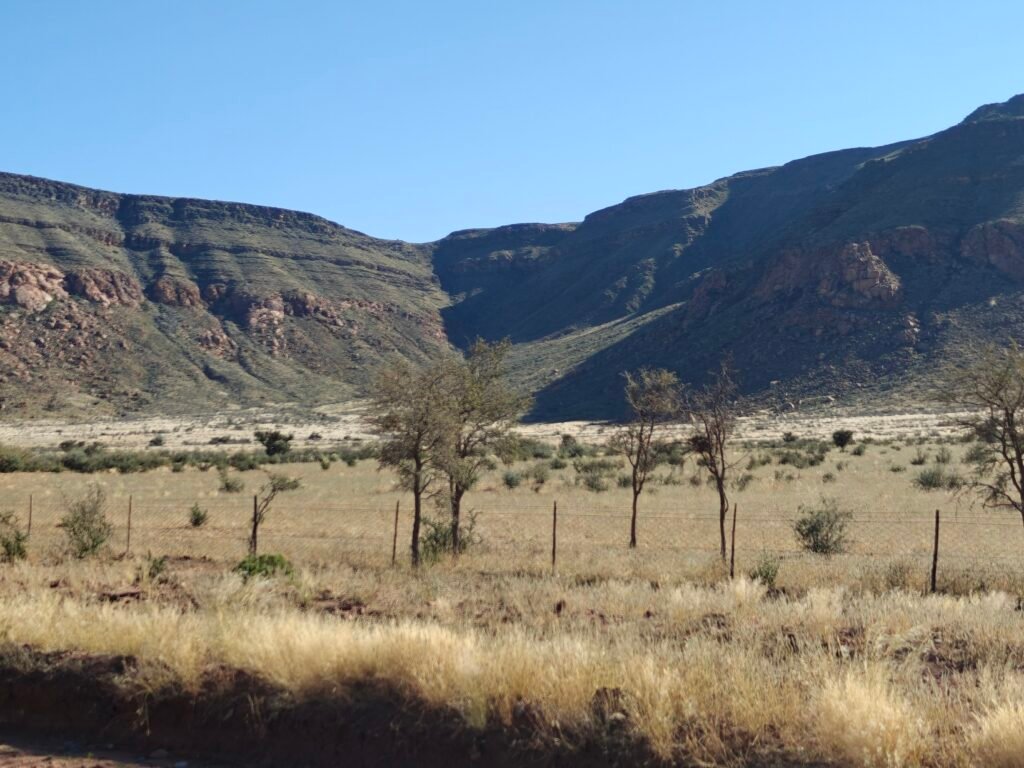
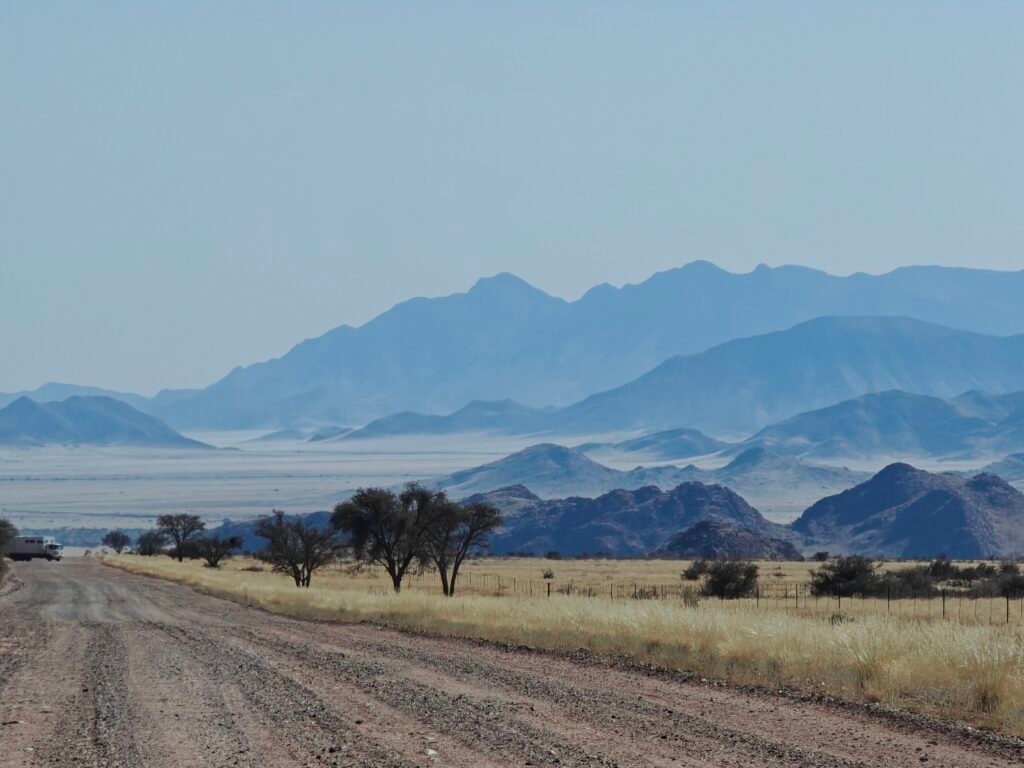
First, to get to Sossusvlei and the Namib Desert we had to travel across the central plateau and descend through the Great Escarpment – the same one we ascended when we left the Tankwa-Karoo. This was a stunning drive down off the escarpment and the approach to the Namib Desert was tantalizing to say the least:
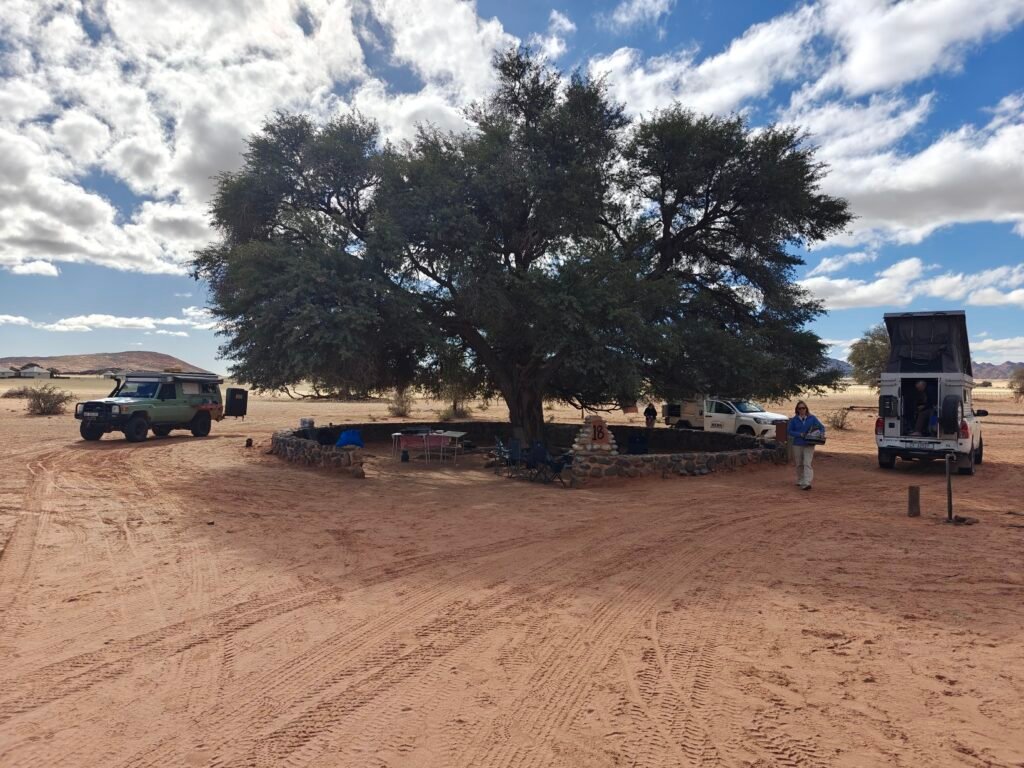
We spent all 3 nights in the Sesrium campground. Our campsite was close to last year’s site, only this time we secured our favorite site in the campground with a seating area and fire pit/brai stand beneath a towering camelthorn acacia with a huge spreading crown, and a circular stone wall around the tree to provide some degree of privacy.
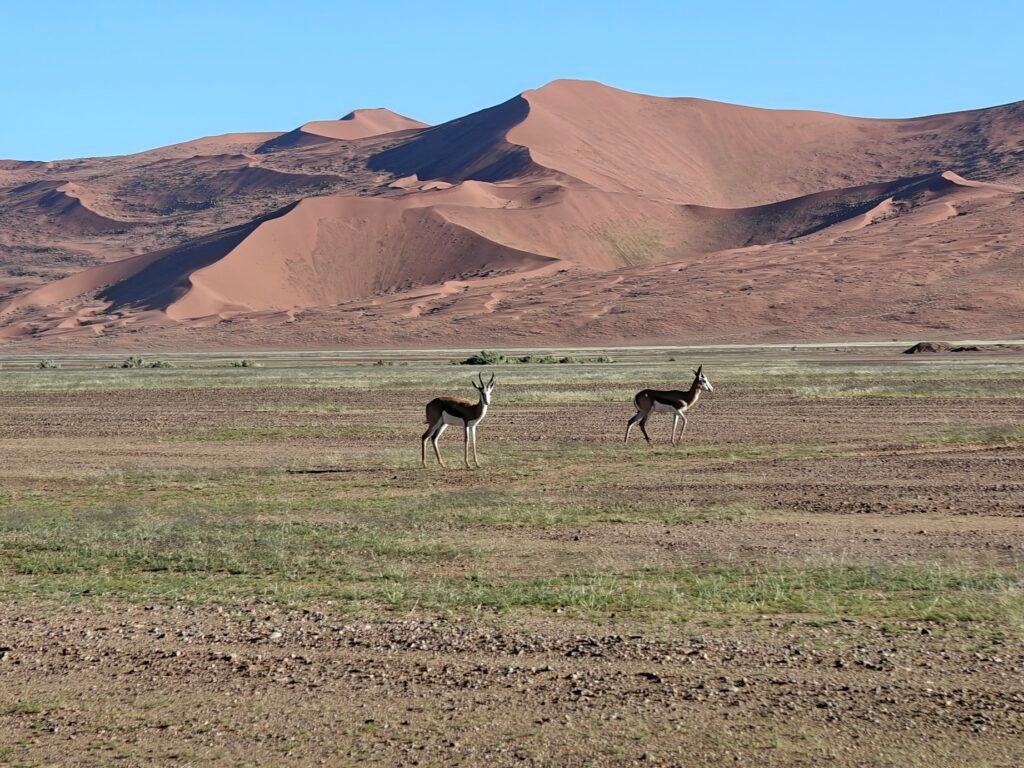
Our day hikes involved driving 60 km up the valley of the Tsauchab River – this is an intermittent river that only rarely has water – surrounded on either side by towering red sand dunes and sparse desert-adapted grasses on the flat plains with occasional Gemsbok and Springbok herds and the odd ostrich:
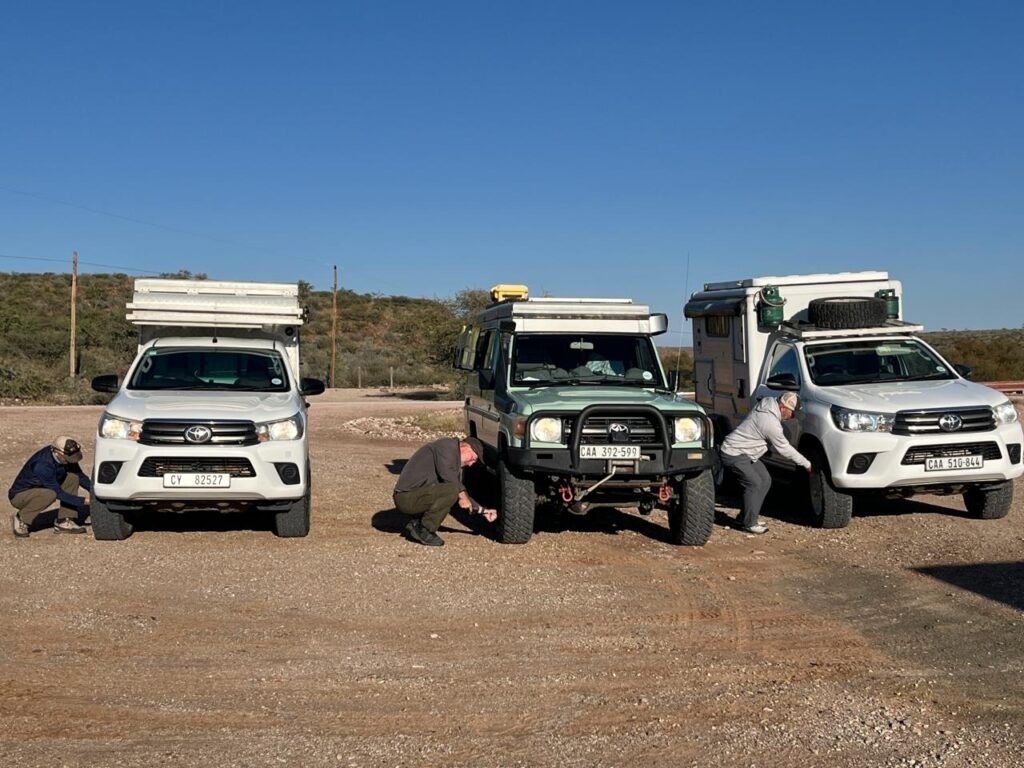
Driving in this country, when road surfaces frequently change from pavement to hard gravel to loose gravel to hard sand to soft sand requires frequent airing up and down the tires. Here’s what that looked like for the guys; while the gals stood watch over the operation with valve covers in hand:
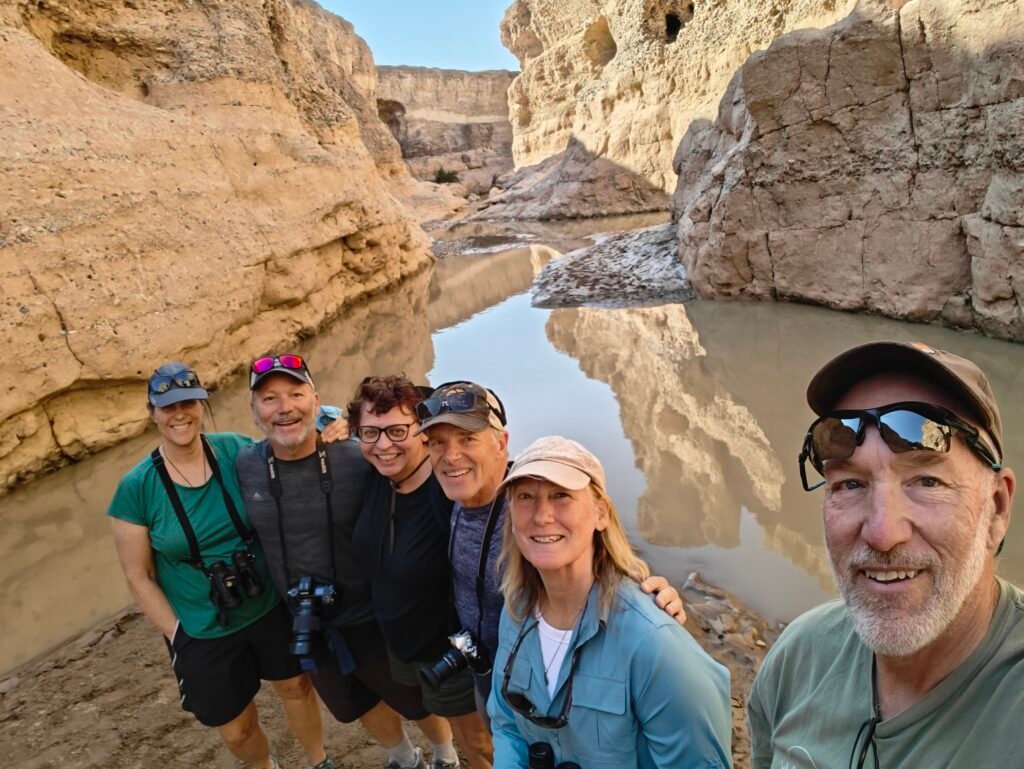
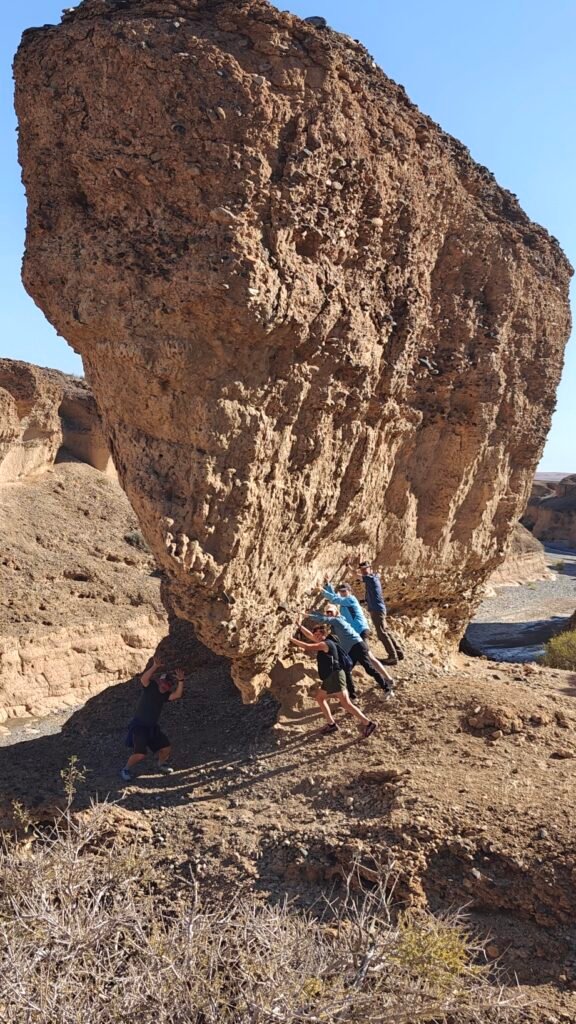
Our first hike after arriving was to Sesrium Canyon. This is a narrow gorge cut down through 20-million year old conglomerate material deposited by rivers over time. The walls of the gorge reveal 100 feet thick of river stones pressed in a mud matrix, all consoladated into a highly erodable material that makes for great canyons. This year, due to the anomalous abundant late-season rainfall, the canyon was partially flooded, so we were unable to get into the narrow part of the gorge – without wading and freezing our begeebees off – but we managed to hike the rim and descend into the lower gorge. Here’s a couple of photos (but see last year’s post for more of the gorge), and note how Mark is fearing for his life as the rest of the gang attempted to topple the mass on top of him:
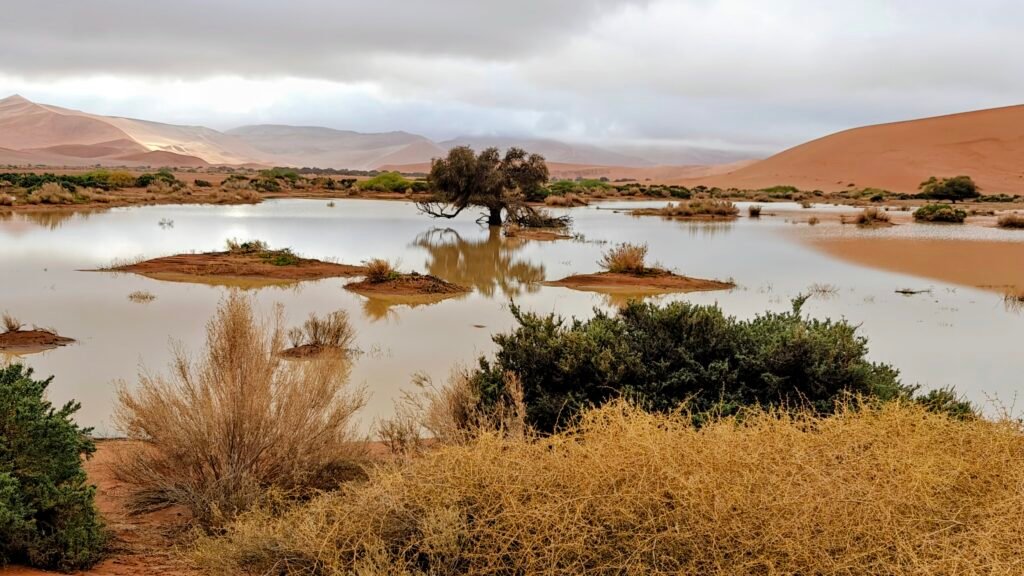
One of the big differences between this year’s visit and last year’s visit was the abundance of water this year. As noted above, this region had anomalous abundant rainfall earlier in the year, leaving behind scattered pools, pans filled with water for the first time in several years, and valleys and stable hillsides with a flush of green vegetation – mostly short grasses. This made for some striking scenes, as shown here:
Of course, the highlight of our visit was the dune hikes and associated pans. Our first dune hike was Big Daddy Dune, the tallest dune in the region at over 1,000 feet, and also the dune climbed by thousands of the most capable tourists. Despite the crowds, it is still something not to be missed – and we did not! The fog and clouds of the morning eventually dissipated to provide us with stunning vistas of the dunes and pans. See the slideshow below for lots more pictures from Big Daddy:
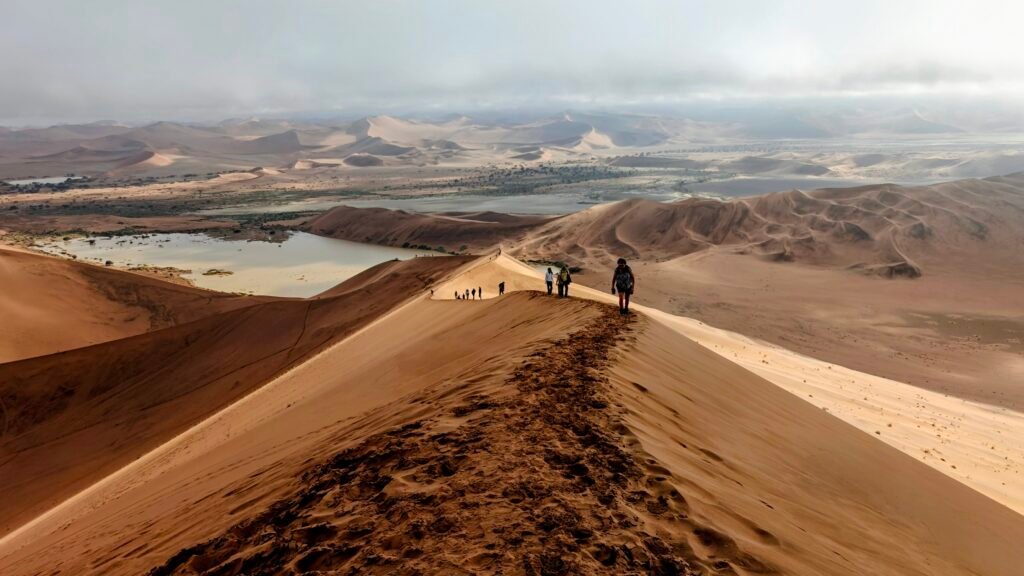
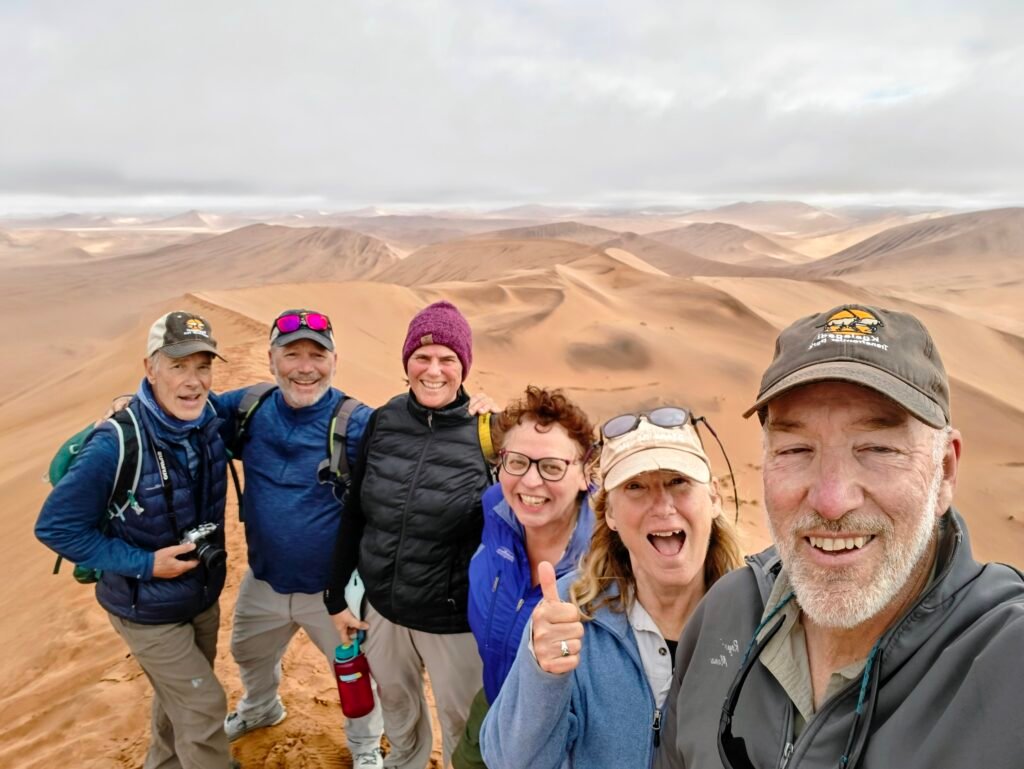
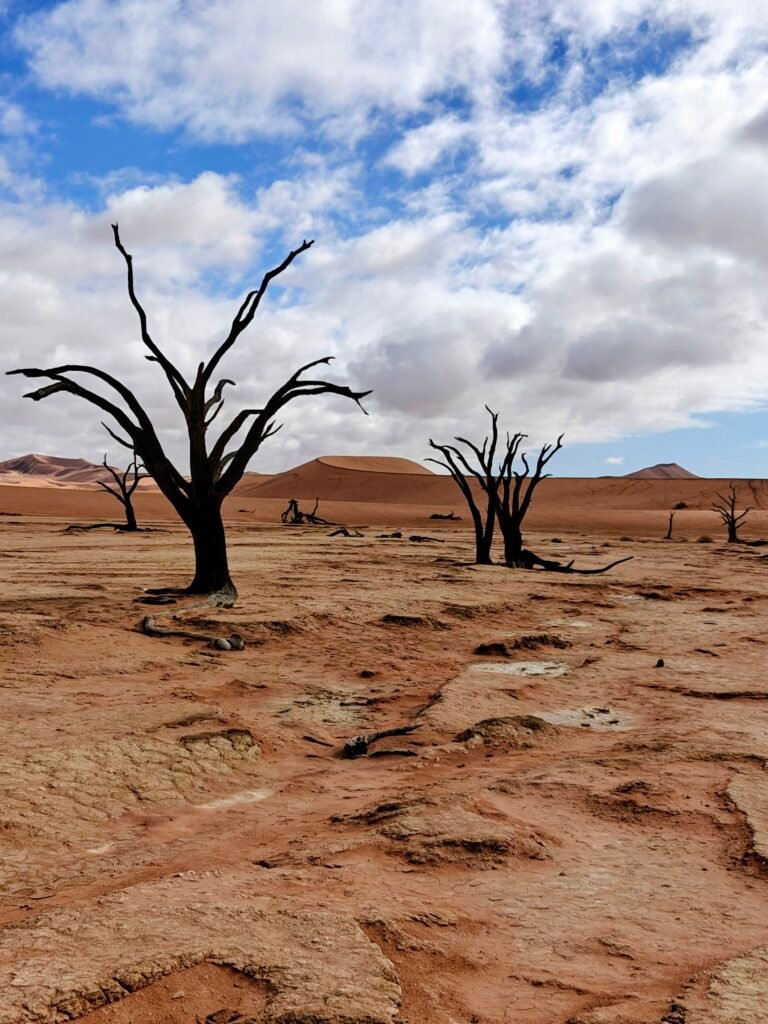
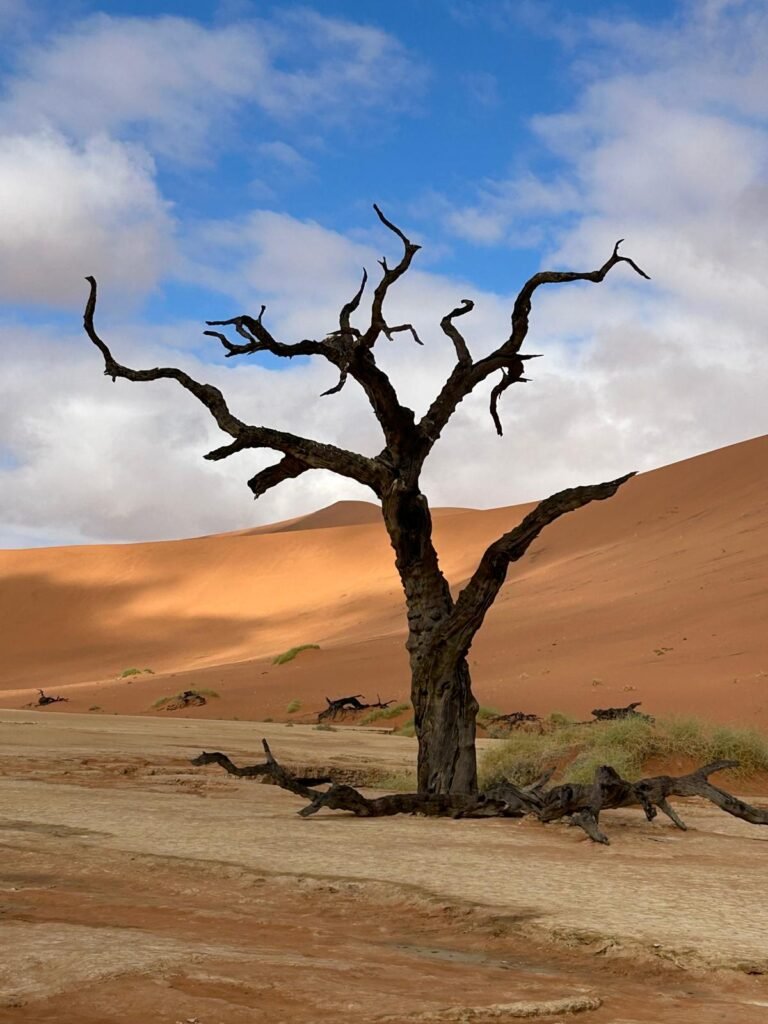
We descended Big Daddy Dune to the most photographed place in Namibia: Deadvlei Pan. This Pan is famous for its fossilized (or skeleton) trees. These trees were established 1,000-1,200 years ago when the Tsauchab River flowed through this area and the trees got established in the floodplain zone. Around 900 years ago, climate change and a shift in the River left this area isolated from the river, and the developing salt pan killed the trees, leaving the eerie-looking skeleton trees:
Our final hike was an exciting ascent of Big Mamma Dune, made challenging by the blowing winds and sand that made walking difficult and keeping the eyes clear of grit impossible – a day later and I am still trying to wash out sand grains from the back of my eye sockets. Annette even had to resort to putting on full-length pants for the first time to keep her legs from getting sandblasted raw. The upside of climbing this dune under such conditions was that no other tourist dared the challenge, so we had it to ourselves – wonderful!
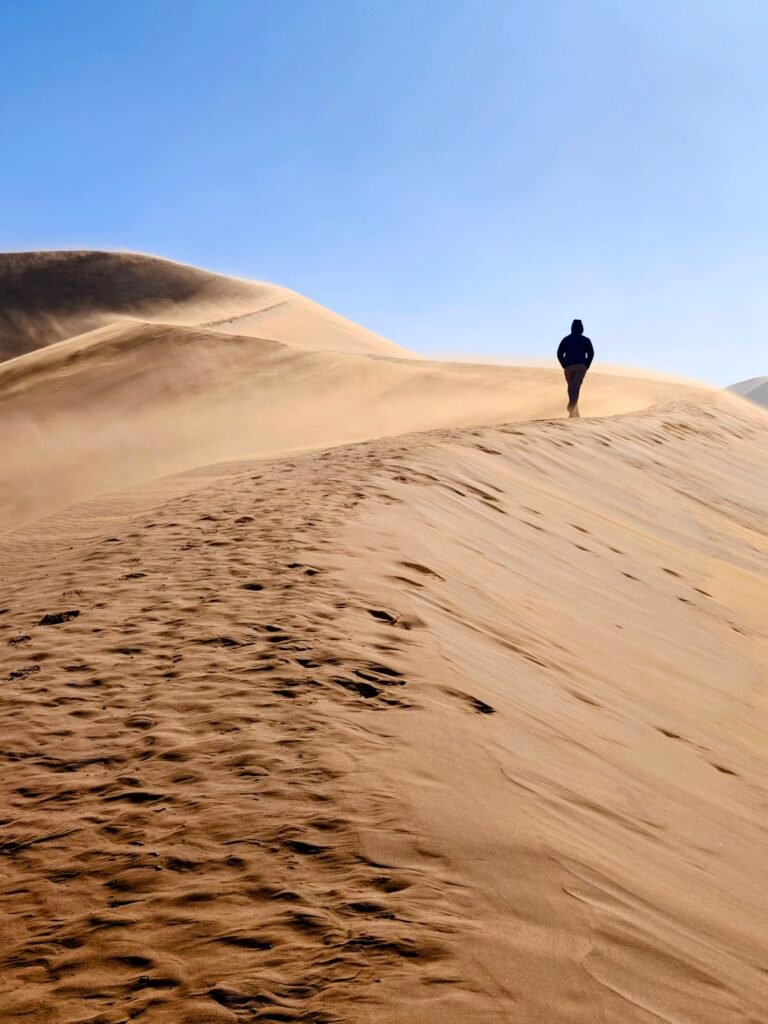
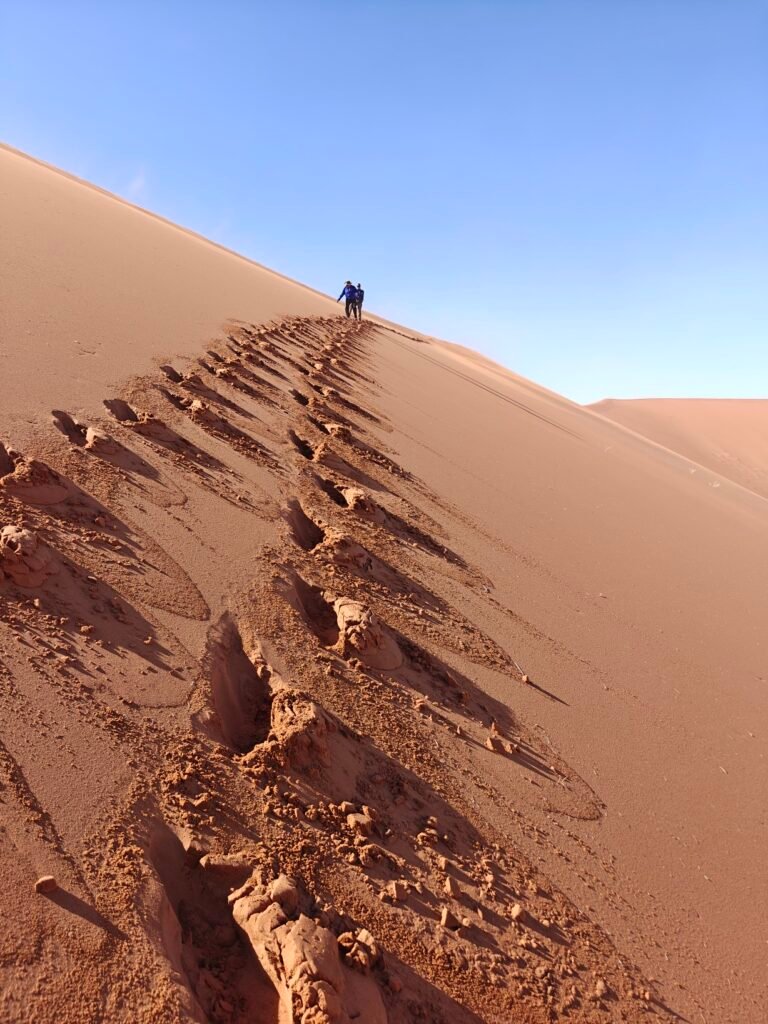
Here’s a short video of our asscent of Big Mamma Dune in the blowing wind and sand:
Big Mamma Dune climb video (2 minutes)
For those that want to see more, here’s a 6-minute slideshow of our entire visit to Sossusvlei this year, starting with photos of our descent off the Great Escarpment to the Namib Desert and each of our hikes. However, I didn’t spend the time to put slides in chronological or logical order, so it’s a bit of a mishmash of photos. Enjoy:
Sossusvlei slideshow (6 minutes)
OK, we are leaving the Namib Desert, but “we’ll be back”, and heading into the nearby Naukluft Mountains for some exhilarating hikes and two nights camping. See you there!
UHHHHMAZING. Love love love the dramatic landscape. You should have put up a sail during that sand storm on the dunes and sandboarded down!
Hi guys!
What beautiful scenery of sand dunes overlooking salt pans and water. So unique ! Not sure about that Big Momma hike but you all are troopers. Did you taste sand in your food? The campsite was really nice with that perfect tree providing shade and privacy. Everyone looks happy! 🙂